Get Full Government Meeting Transcripts, Videos, & Alerts Forever!
Get email alerts on the Ai Policy topic
No spam. Unsubscribe anytime.
AI task force backs standing advisory body but rejects labor, data-center and some workforce safeguards
Summary
The Attorney General's AI Task Force voted to create a standing advisory body on AI and approved a recommendation tied to recently passed legislation, while three other proposed recommendations on labor notice, data-center guidance and public-sector bargaining failed to gain majority support. The final report will be released by July 1.
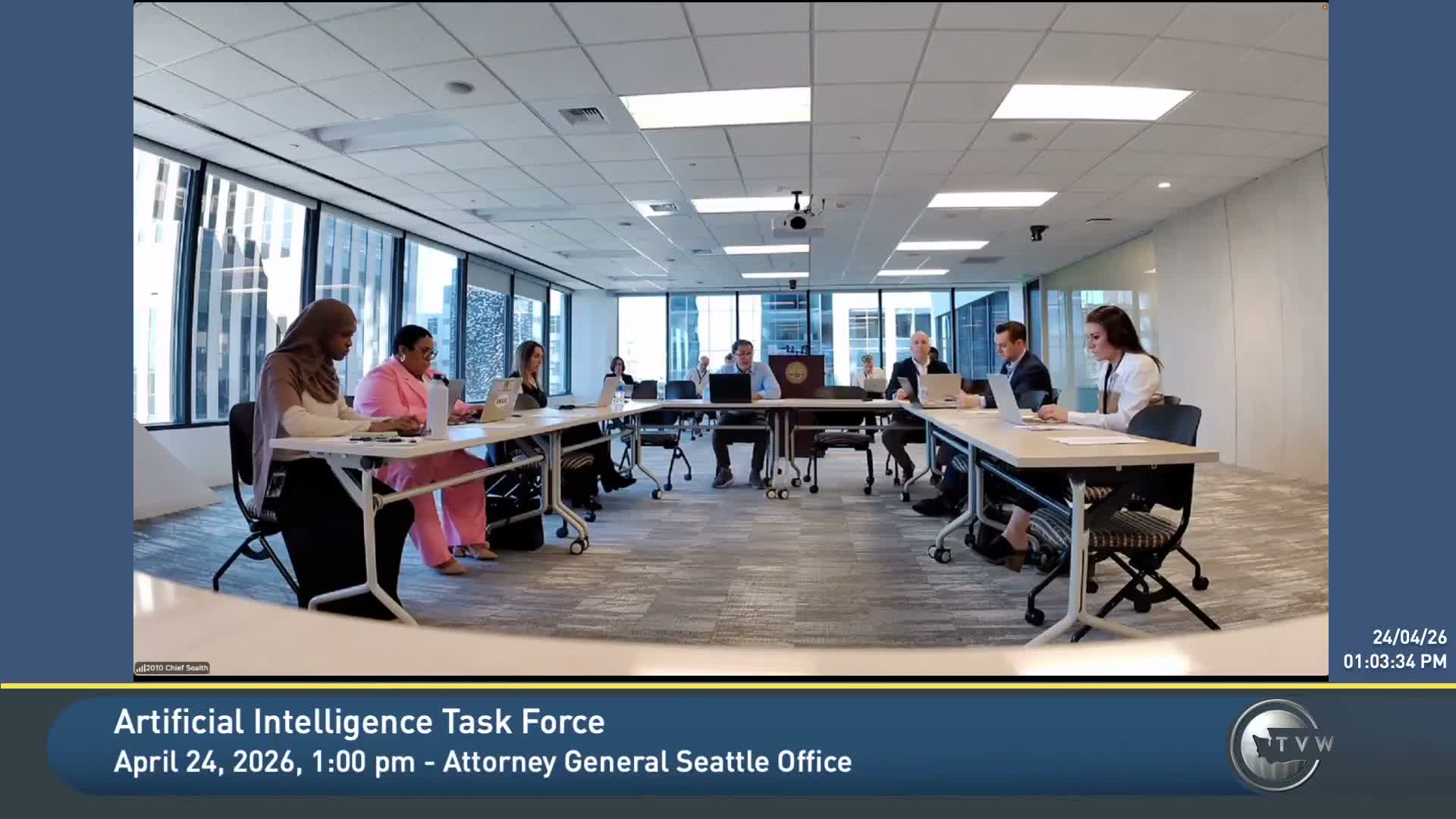
The Attorney General's Office's AI Task Force adopted a recommendation to establish a standing advisory body to monitor and advise on AI issues but rejected three other recommendations after protracted debate Thursday.
G. Ishizuka, a senior policy analyst in the Attorney General's Office and chair of the task force, opened the meeting by saying the group's purpose was "to vote on policy recommendations related to the use of AI in Washington." The meeting, streamed live, included public comment and roll-call votes on five recommendations drafted by subcommittees.
Why it matters: The standing advisory body (recommendation 5) was intended to provide continuing scrutiny of emergent AI technologies beyond the task force's last meeting. Supporters said it would allow the state to track unforeseen harms and preserve channels for technical advice as systems evolve.
Debate and outcomes: Public commenters and task force members raised sharply different views on recommendations that addressed labor protections, data-center impacts and bargaining rights. Mary Joyce, who identified herself as founder of a policy-consulting firm, told the group she appreciated the focus on marginalized communities but warned that removing references to data-center electricity use could "pretend that there's not an energy issue." She also criticized changing a proposed oversight body to an advisory body as "watering down the power of that body." Rose Feliciano of TechNet urged Washington-specific analysis and made a case for aligning recommendations with existing law.
The task force approved Recommendation 1, which recognizes overlap with recently enacted HB 2225 and will be reflected in the final report, and adopted Recommendation 5 to create a standing advisory body. Votes on the other items failed. Recommendation 2—which would have required six months' notice to labor organizations for consequential generative-AI changes—fell short after members raised concerns about cost and operational burden; labor representatives and some members said the notice was essential to protect workers. Recommendation 3, dealing with data-center guidance and possible ratepayer protections, drew sustained objections from members who said it was outside the task force's scope and better handled through the governor's data-center work group or the Utilities and Transportation Commission. Recommendation 4, proposing stronger bargaining rights for public-sector employees around AI adoption, also failed after members warned it would impose large new costs and could conflict with management rights.
Vote tallies announced by roll call: Recommendation 1 (approved; majority). Recommendation 2 (failed; 8 yes, 9 no, 1 abstain as announced). Recommendation 3 (failed after final vote; 6 yes, 10 no). Recommendation 4 (failed; 3 yes, 12 no). Recommendation 5 (adopted; announced as 15 yes).
Contentious exchanges: Charlie Brown, speaking for a data centers coalition, urged the task force not to adopt Section 3 on data centers, saying those issues involve electricity rates and are "more appropriately set out" through the UTC or local utilities. Supporters of labor-centered provisions cited implementation failures such as payroll errors tied to recent HR system rollouts and said workers would face real harm if not included in decisions that materially alter wages or hours.
What's next: Staff from the Attorney General's Office and the Health and Government Operations office will draft the final report reflecting votes and circulate edits. The chair said the final report will be released by July 1. With that, the chair adjourned the task force's last full meeting.
Quote highlights: "The purpose of today's meeting is to vote on policy recommendations related to the use of AI in Washington," G. Ishizuka said. Mary Joyce said she was "a little concerned about removing the references to electricity from the data center piece." Charlie Brown said the data-center language was "outside the scope" of the task force.
The task force concluded without adopting the more prescriptive labor and data-center proposals but left a standing advisory body in place to continue monitoring AI policy questions.