Get Full Government Meeting Transcripts, Videos, & Alerts Forever!
Get email alerts on the Hb1001 Implementation topic
No spam. Unsubscribe anytime.
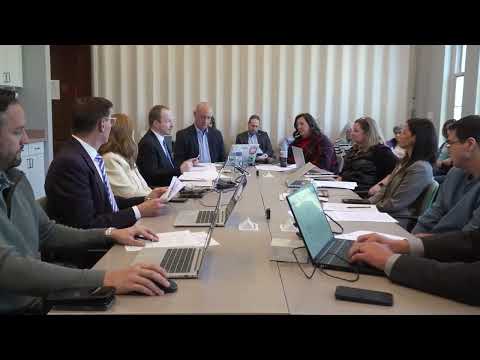
Carmel officials outline compliance steps, deadlines and concerns after House Bill 1001 briefing
Summary
At a special Carmel City Council briefing, staff outlined annual reporting, fee limits and required UDO review under House Bill 1001, including a required public hearing by Jan. 1, 2027; council members raised concerns about unfunded mandates, fee subsidies and conflicts with other state statutes.
Carmel city officials met in a special council briefing to review the new requirements under House Bill 1001 and to discuss next steps for local implementation. Staff reported that the law creates annual housing-reporting duties, caps on certain development fees and a mandate to review local zoning rules with the explicit goal of increasing housing production.
Adrian, speaking for city staff, said the statute’s housing-progress report will require “the number of housing units proposed, the number of housing units that might be denied,” plus detailed status breakdowns (rezoned, platted, built), calendar days to process applications and pricing data such as median home-sale and rent prices. Adrian said the city will likely partner with outside providers such as MIBOR to obtain sales and rent data and that the completed report must be filed with the executive director of the Legislative Services Agency by January 2027, covering the prior year.
Sergei, a city staff member leading the legal and ordinance review, emphasized fee and UDO implications. He warned that “starting 12/31/2026, a unit may not assess a fee in an amount that is more than reasonably necessary to cover the applicable cost” of processing applications and inspections, and described a new five‑year limit on general fee adjustments tied to the national consumer price index beginning January 2027. He also noted the law expands the time between fee introduction and implementation from 90 to 180 days unless the city uses an expedited process.
Council members raised practical concerns about those rules. Several said Carmel currently subsidizes much of its application and inspection work and that the statute’s “reasonably necessary” test could either reveal larger municipal subsidies or prompt higher user fees. One council member said a careful accounting of staff hours and technology costs will be needed; another asked staff to track administration time so the city can justify any future fee adjustments.
On zoning, Sergei laid out the law’s central compliance step: no later than Jan. 1, 2027 the city must hold a public hearing to review the Unified Development Ordinance (UDO) against nine state-specified factors — including allowing duplexes, triplexes and quads in single‑family zones, encouraging accessory dwelling units, considering adaptive reuse of commercial buildings, increasing floor‑area allowances for multifamily areas, waiving certain design standards (setbacks, parking, garage sizes), reviewing impact‑fee zones, shortening permitting timelines, exploring property-tax abatements for mixed‑income housing, and options for donating vacant land for affordable housing. Sergei said the final report must include minutes from the required hearing and a written description of any newly developed or amended UDO provisions that use one or more of those factors.
Council responses mixed caution and confidence. Several members urged transparency — telling staff to make it clear in the forthcoming public hearing that the changes flow from state legislative intent so residents can contact their state representatives — while others pressed staff to document Carmel’s prior work and submit that history to the state portal as evidence that the city already meets many of the law’s objectives. One council member asked city legal to prepare a memo showing how HB 1001 interacts with existing statutes, especially claims it may conflict with the state’s prohibition on unfunded mandates, impact‑fee rules, and other statutory limits.
Staff also flagged legal uncertainty about the statute’s language on donating vacant land for affordable housing, saying property‑disposition statutes and intergovernmental rules likely constrain any direct donation to private developers and that nonprofit or intergovernmental channels would be more feasible.
Next steps identified in the briefing included: staff tracking processing times and compiling data partners for price/income figures; introduction of a fee‑ordinance amendment to the Plan Commission in May; a decision on whether the required UDO/public hearing will be held by the Plan Commission or by the council itself; and a legal memo on statutory conflicts and constitutional questions raised by one council member. No formal votes or motions were taken at the meeting; the session adjourned at 5 p.m.
What happens next: staff will return with draft ordinance language and timing recommendations, the housing commission will continue UDO scans (Opticos was mentioned as returning with a UDO scan), and council will be asked to give direction about the hearing format and any redlines to proposed UDO amendments.