Get email alerts on the Climate Commitment Act topic
No spam. Unsubscribe anytime.
City briefed on Climate Commitment Act implications for municipal gas utility, potential million‑dollar future costs
Summary
City Administrator Chris Searcy told the Uniontown City Council the Climate Commitment Act (CCA) already pulls the municipal gas utility into regulation and that declining no‑cost allowances, carbon price uncertainty and potential linkage with other markets could push annual compliance and program costs substantially higher; staff recommended council consider policy positions and options including alternative compliance pathways and targeted grant funding.
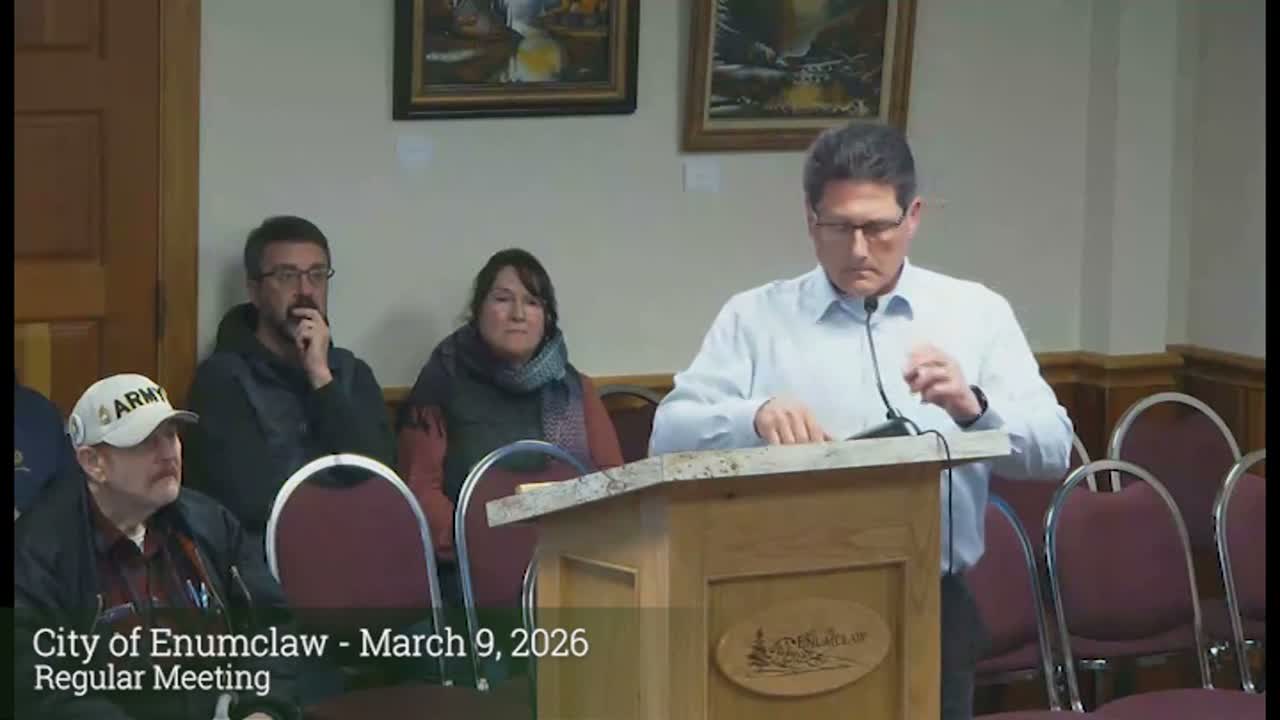
City Administrator Chris Searcy told the Uniontown City Council on March 9 that the state’s Climate Commitment Act — a cap‑and‑invest program enacted in 2021 — now applies to the city’s natural gas utility and will require the utility to obtain carbon allowances equal to its greenhouse‑gas emissions.
Searcy said Uniontown is “just marginally over” the 25,000 metric‑tons CO2e threshold that pulls an entity into the program, with average emissions for 2023–2025 slightly above that limit. He explained Ecology provides some “no‑cost” allowances for covered entities based on a baseline and that those allowances decline each year (about 7% annually), while the share the city must consign to auction increases and will reach 100% by 2030. That combination reduces free coverage over time and increases the utility’s out‑of‑pocket compliance costs.
Why it matters: Searcy said the city already recovers the program cost through a CCA compliance charge on customer bills, split between legacy customers (connected prior to July 25, 2021) and non‑legacy customers (those connected after that date). Legacy customers receive some offset from auction proceeds; non‑legacy customers do not and therefore face a larger immediate bill impact. Searcy gave historical figures (CCA program costs starting at about $250,000 in 2023 and rising in recent years) and said staff can produce updated year‑by‑year projections, but emphasized that future totals depend heavily on carbon prices and whether Washington links with other carbon markets.
Options under consideration: Searcy outlined potential policy responses the council might consider in coming months: (1) pursue full cost‑recovery for new development to limit growth in the city’s gas load, (2) work with other municipal utilities (Ellensburg was mentioned) to seek an alternate compliance path through the Legislature or a restricted‑account approach, (3) seek grants or state appropriations for decarbonization planning and implementation, or (4) develop local programs to reduce gas demand (for example, incentives or technical assistance to move space/water heating off gas). He warned staff capacity is limited and that implementing customer‑facing programs would likely require additional personnel or outside technical resources.
Council members pressed for clearer projections. Councilmember McClure asked for a ballpark of net costs and whether the city’s projected exposure could exceed $1 million annually; Searcy said projections can reach into the high hundreds of thousands and could exceed $1 million depending on carbon price trajectories and market linkage. Searcy also noted the city appealed Ecology’s baseline calculation and lost, which limited early avenues to avoid coverage.
What’s next: Searcy recommended council discuss the item again in May, allow members time to review materials, and decide whether to pursue legislative or grant strategies with peer municipal utilities. No policy decisions were made at the March 9 meeting.
Quotes: “It is the law. We need to follow it,” Searcy told the council, adding that the city’s average emissions for 2023–2025 left it “just barely” over the threshold.
Ending: The council took no action at the meeting; staff will return with updated cost projections and potential policy options for further council direction in a future agenda.
AI generated
The text on this page is AI generated. Summaries, highlights, analysis, and video transcripts are all produced from the original source material.
AI can make mistakes, so if you spot one, and we will fix it for everyone.
Note: the source content is unaltered by us. Any content source we link to, be it a video, an audio recording, or a document, is presented exactly as its publisher released it. That publisher is usually a government body, sometimes an individual official or another organisation.