Get AI Briefings, Transcripts & Alerts on Local & National Government Meetings — Forever.
Luma Energy president tells House committee the company has invested in islandwide reconstruction and seeks reactivation of FEMA projects and municipal deals
Loading...
Summary
Yanis Quiñones Mercado, Luma Energy president, told the Puerto Rico House Government Committee that Luma has invested in capital and operational efforts, outlined vegetation and streetlight programs, and asked regulators and municipalities to help reactivate FEMA‑funded projects and streamline municipal MOUs; legislators pressed for documentation and data within five days.
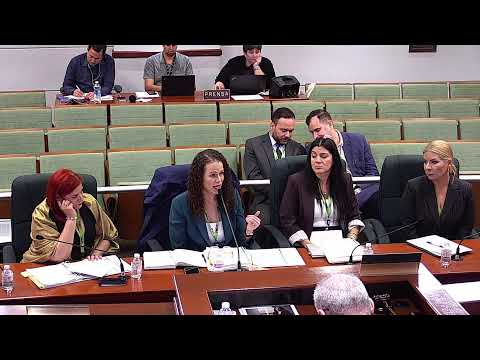
Yanis Quiñones Mercado, president and CEO of Luma Energy, told the House Government Committee on April 16 that Luma has been investing in both capital projects and day‑to‑day operations and outlined a plan to accelerate vegetation management, replace degraded poles and expand streetlight modernization if FEMA and local processes allow.
Quiñones opened by summarizing Luma's submitted memorial and described two vegetation programs: an island‑wide, one‑time FEMA‑funded clearance intended to remove incompatible vegetation from transmission and distribution rights‑of‑way, and an ongoing operations‑funded program focused on priority circuits to address immediate safety and reliability risks. She said Luma has begun using LIDAR mapping to reduce survey times from months to less than a month and to prioritize field work more efficiently.
On streetlighting, Luma's testimony said the company has modernized roughly 188,000 luminaires since June 2021. Quiñones and Rebeca Maldonado, Luma's director of government and public policy, testified that the Autoridad de Energía Eléctrica's recent reclassification of certain FEMA projects led to 71 public‑lighting projects being inactivated in FEMA's portal, and that 35 priority lighting projects were ordered by the Negociado de Energía to be re‑submitted to FEMA for reactivation. Luma proposed eliminating undergrounding work from a subset of projects to reallocate about $140,000,000 toward additional above‑ground fixtures and pole replacements, which would allow reactivation of additional stage‑2 and stage‑3 projects.
Committee members pressed for exact figures; Luma stated multiple amounts during testimony (the transcript contains mixed formatting for some numbers). Luma said approximately 378,000 luminaires across the island need attention, that 188,000 have been replaced, and that an additional 88,000 fixtures are included in near‑term plans. Management emphasized that project reactivation depends on the consolidated project list the Autoridad de Energía Eléctrica submits at the direction of the Negociado and on available federal funds.
Maldonado described procurement and quality‑assurance procedures: Luma publishes requests for proposals on its electronic sourcing platform, requires factory acceptance testing with suppliers and inspects delivered materials on arrival. The company said it has a catalog of technical specifications and requires a pole load structural analysis for all reconstructed lines. Quiñones said current material purchases meet Luma's engineering standard (which she described as designed to resist winds up to 160 mph) and that Luma will not install poles that fail to meet the standard.
Why it matters: Luma's presentation lays out how the utility intends to apply federal disaster funds and operational resources to visible services (streetlighting) and to system reliability (vegetation, poles and sectionalizing). Reactivation of FEMA obligations and clear municipal MOUs are necessary steps, and the company requested regulatory coordination so federal funds can be used efficiently.
What committee members asked for and next steps: Committee members repeatedly requested supporting documentation and data (project lists, obligations, procurement records and a breakdown of federal funds recouped). Luma agreed to provide requested documentation and numerical backup within five days. The committee adjourned after the parties agreed to submit the specified records.