Get Full Government Meeting Transcripts, Videos, & Alerts Forever!
Get email alerts on the Municipal Finance topic
No spam. Unsubscribe anytime.
Oak Harbor finance director outlines secondary revenue streams, legal limits and 2024 figures
Summary
David Goldman, the city's deputy administrator and finance director, presented Oak Harbor's 2024 revenue mix beyond property and sales taxes, highlighting a $3.7 million utility-tax contribution, the market-sensitive real estate excise tax, $1.6 million in fuel-tax shares for roads, variable grant receipts (including $7.2M in 2022 from ARPA), and development fees that fund growth-related infrastructure.
David Goldman, deputy city administrator and finance director for the City of Oak Harbor, outlined the city's secondary revenue portfolio at part 3 of the city's revenue series, stressing that utility taxes, state-shared revenues, user fees and one-time grants complete the municipal funding picture beyond property and sales taxes.
Goldman framed the presentation as a technical look at restricted and variable sources that underpin public services and capital work. He said the utility tax is Oak Harbor's most consistent unrestricted contributor outside the general fund: "In 2024, this source generated an actual revenue of $3,700,000," with sewer, electric and storm-drain charges among the largest components.
The finance director cautioned that some important revenue streams are legally restricted or inherently volatile. He described the real estate excise tax (REET) as a capital-focused revenue that rises and falls with the housing market; Oak Harbor recorded roughly $900,000 from REET in 2024 after a prior high near $1.3 million. Goldman stressed that, by state law, REET proceeds are generally reserved for capital projects and cannot be used for routine operating costs such as staff salaries.
Goldman also discussed state-shared revenues. He said the state collects taxes such as the motor fuel and liquor taxes and redistributes portions to cities using per-capita formulas, but those formulas can change and the state's July-to-June fiscal year differs from the city's calendar year, which "essentially forces the city to budget in the dark for several months each year." He identified motor vehicle fuel tax receipts as a user-pays source for roads and said Oak Harbor received about $1,600,000 from that source in 2024; under the state constitution, those funds are restricted to street and highway purposes.
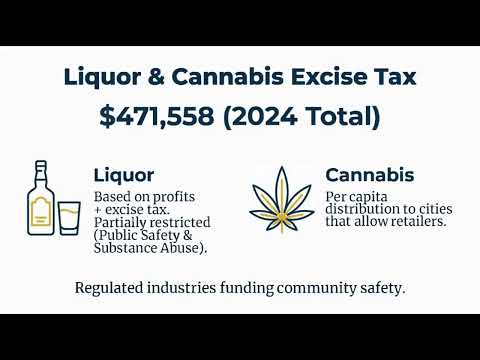
Goldman summarized excise or so-called "sin" taxes while noting their restricted uses: liquor-related revenue is based on profits and excise taxes, and cannabis revenues are distributed per capita to jurisdictions that allow retail sales; the city's excise receipts were about $471,000 in 2024 and are partially earmarked for public-safety and substance-abuse programs.
On grants, Goldman warned against treating them as a reliable base: Oak Harbor's grant receipts were about $619,000 in 2019, jumped to $7.2 million in 2022 largely due to American Rescue Plan Act funds, and were about $1.3 million in 2024. "Grants are a bonus, not a foundation," he said, and therefore not appropriate to fund recurring operations.
Goldman described enterprise fund rules that keep utility charges (for water, sewer and similar services) legally segregated from general-government spending, and he gave 2024 figures for user-fee categories: roughly $152,000 from recreation fees, about $400,000 from impact fees, and $635,000 from system development charges (SDCs) used to expand utility capacity for new development.
He closed by pointing listeners to the MRSC revenue guide for Washington cities for a deeper technical review, reaffirmed the city's commitment to fiscal transparency, and provided financequestions@oakharbor.org for further inquiries. The presentation did not include motions or votes; it was an informational session.