Get Full Government Meeting Transcripts, Videos, & Alerts Forever!
Get email alerts on the Education Hbcu topic
No spam. Unsubscribe anytime.
New Haven committee approves application for state planning grant to study HBCU options
Summary
The New Haven Board of Alders' education committee voted to apply for up to $250,000 in state planning funds, with a proposed $50,000 city match, to study models — from a new campus to a nonprofit consortium — for establishing a Historically Black college or partnered HBCU programming in New Haven.
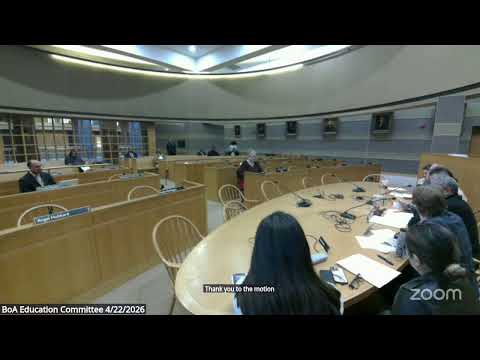
The New Haven Board of Alders' education committee voted Wednesday to seek a Connecticut Department of Economic and Community Development planning grant of up to $250,000, with a proposed $50,000 city match, to study options for establishing a Historically Black college or a consortium-linked HBCU presence in the city.
The application — listed on the agenda as item LM20260044 — asks permission to pursue Community Investment Fund planning dollars to underwrite a feasibility and governance study for the initiative. A presenter for the proposal said the grant request would fund planning activities and that applying does not commit the city to construction or immediate spending.
"This is not a commitment to build; we are asking for permission to go for these funds," the Presenter said during the meeting, describing a planning budget built around a $250,000 state grant and a $50,000 local match.
Why it matters: supporters told the committee the project could address long-standing educational and economic gaps by creating culturally supportive higher-education pathways and by drawing regional and out-of-state students. Proponents said the effort also responds to a historical effort to found an HBCU in New Haven that did not succeed in the 19th century.
The presenter laid out two primary models the feasibility work would examine: pursuing a standalone institution (which would face federal designation requirements) or forming a nonprofit consortium (a 501(c)(3)) that would partner with established colleges to share courses, facilities and services. The presenter cited examples of consortium-based approaches used elsewhere to reduce capital strain on individual campuses.
Public commenters — including local educators, alumni-network organizers and longtime graduates — urged the committee to pursue the study while emphasizing conditions they want to see if the idea advances. "This has to be Black owned," one commenter said, urging local ownership of land and governance. Alice Coleman, who identified herself and her New Haven address for the record, said the proposal "shows the importance of this type of institution in this particular town," and offered the group's assistance with outreach.
Committee members asked about progress contacting potential partner institutions and about timeline and scope for a feasibility study. The presenter said informal conversations with higher-education partners had taken place but no commitments had been made and that the feasibility phase would produce materials the city could use to issue an RFQ/RFQ-like solicitation to attract operating partners.
Procedural action: a motion was offered to amend the item language from "SIP round 8" to "SIP round 9." The committee approved the item as presented by a voice vote and instructed staff to proceed with the application process.
Next steps: staff will submit the CIF planning grant application on the city’s behalf and return to the committee with findings and recommended governance options if the city is invited to proceed. The committee did not vote on any construction or long-term financing in this meeting.
(Reporting based solely on the committee meeting transcript.)