Get Full Government Meeting Transcripts, Videos, & Alerts Forever!
Get email alerts on the Transportation Impact Fees topic
No spam. Unsubscribe anytime.
Covington staff propose $722-per-trip transportation impact fee; council debates ADU charge
Summary
City staff presented a proposed update to Covington's transportation impact fee, asking council to confirm data and approach; staff said the proposal would equate to about $722 per daily trip (roughly $7,276 for a new single-family home) and raised whether accessory dwelling units should be charged up to 50% of the single-family fee.
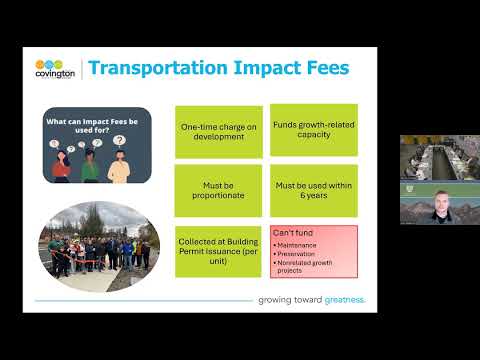
City staff presented a proposed update to Covington's transportation impact fee at a March 4 joint study session and asked the City Council for direction on data, calculations and implementation. Staff said the update would charge approximately $722 per daily trip, which they said produces an example single-family charge of about $7,276.
The discussion mattered because Covington's impact fee has not been updated since 2012. Staff said the proposed update is tied to the 2024 comprehensive-plan growth allocations and a 20-year capital assessment. "What we're proposing is that it comes out to approximately $722 per trip," said Salina Lyons, the community development director, during the presentation. She and consultant Josh Anderson asked council whether they supported the underlying data and the implementation approach staff described.
Why it matters: the city's comp-plan lists roughly $134.3 million in projects, but staff said only about $92—3 million qualify as capacity projects for impact fees. Based on historic grant-success projections, staff estimated roughly 41% of those capacity project costs could be covered by public funding, leaving about $54 million as an unfunded share that would be allocated across projected trips. Staff told council the trip forecast used 2022 counts projected to 2044, a growth that was stated as roughly 76,000 additional daily trips.
How the fee was calculated: consultant Josh Anderson explained the methodology in four parts—identify capacity projects tied to the comp plan, estimate likely public funding (grants), forecast trip growth over the next 20 years, and spread the unfunded portion across those trips to arrive at a per-trip fee. Anderson described using the Institute of Transportation Engineers (ITE) trip-generation rates to convert trips into per-project fees. "The numbers you see in tables 5 and 6 ...are the ones that apply to the impact fees, not the full comp-plan total," Anderson said.
Council questions focused on distributional effects and technical details. Members asked who pays the fee at permit issuance (staff said the builder/developer pays the city at building permit, and developers typically pass costs into sale prices) and how credits are applied when existing structures are demolished and replaced. Staff said credits are preserved for existing units and that new construction pays the net difference.
Accessory dwelling units: staff flagged a state law change (identified in the discussion as HB 1337) that allows cities to assess up to 50% of the single-family impact fee on accessory dwelling units (ADUs). Lyons said a 50% ADU charge would be roughly $3,600 under the proposed numbers and asked whether council wanted staff to draft code to apply that allowance. Several council members expressed concern that charging ADUs at 50% could reduce affordability, pointing to other upfront costs such as sewer and utility connections. "I would say that's way too much," said Councilmember Christina Soltis in a 60-second intervention. Another councilmember noted the broader cost drivers for ADUs, including utility hookup costs, and supported returning with options.
Other technical points: staff noted the state allows cities to include multimodal capacity (not only automobile capacity) in impact-fee calculations. Anderson said signal timing and controller upgrades can yield small capacity gains (often in the 10—15% range) at a lower cost than adding through lanes, and that those signal projects can be included in the TIP/CIP where appropriate.
Next steps and disposition: council gave informal consensus to the data and approach and asked staff to return with code language and a focused ADU analysis. Lyons told council she would bring code updates and the ADU options back to a future meeting; staff also said planning commission work on code alignment would follow. The study session concluded and adjourned at 6:50 p.m.