Get Full Government Meeting Transcripts, Videos, & Alerts Forever!
Get email alerts on the Planning Work Plan topic
No spam. Unsubscribe anytime.
Covington council, planning commission review 2026 work plan amid mounting state mandates
Summary
Community Development Director Salina Lyons presented the Planning Commission's 2026 work plan to the Covington City Council and Planning Commission, highlighting completed housing mandates, pending code updates tied to climate and subdivision rules, limited grant funding and heavy consultant reliance to meet state deadlines.
Community Development Director Salina Lyons told the Covington City Council and Planning Commission at a Feb. 24 joint session that the Planning Commission's 2026 work plan centers on implementing recent mandates and finishing several major code updates.
Lyons said the department has split the packet into two parts: the Planning Commission's work program and the broader Community Development department work plan. She noted the commission's priorities are guided by the city's strategic plan and the recently adopted comprehensive plan, and that staff will rely on a mix of in‑house capacity and consultants to complete legislative work.
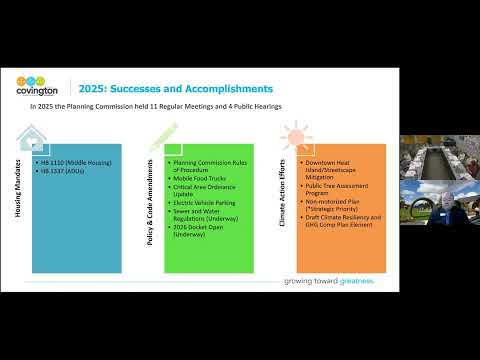
The presentation listed successes from the last cycle, including completion of housing mandates, drafting a climate resiliency and greenhouse gas element (required under a recent state climate law), a tree assessment, a non‑motorized plan and downtown streetscape work. Lyons also said grant funding has helped but is limited: a recent climate grant covered $89,000 of work and will not fund the entire code update process.
Councilmembers pressed staff on the state's shortened review timelines and consolidated (concurrent) review process for layered permits. Lyons explained the current statutory clock is 120 days to process development applications but that the state is considering reducing that length; consolidated review can also elevate a project to the highest review level, meaning more cases would go to the hearing examiner rather than be decided administratively.
Lyons described the department's staffing as a roughly 12‑person core team supplemented by consultants for technical specialties (stormwater, critical‑area review, long‑range planning). She said consultants function as a scalable lever when filing volumes spike, and that the department uses consultant contracts to meet technical demands while managing budget constraints.
Councilmembers asked the department to flag early when workloads threaten the city's ability to meet statutory deadlines. Lyons agreed and said the department monitors compliance through an annual report; she also pointed to a regional data effort—led by the Puget Sound Regional Council—that will provide richer benchmarking by 2029.
The department emphasized use of a gap analysis to prioritize code amendments: staff review where current municipal code is inconsistent with state law (for instance, code references to "dormitory" use, missing definitions for sleeping units and kitchenettes, and parking standards that exceed the state's new limits). The gap analysis helps staff focus limited funds and consultant time on the items that are legally required or most urgent to implement.
Lyons said the Planning Commission and Council will have additional joint meetings through the year as code amendments are developed and that the Council can add items to the work plan if new priorities emerge.
The joint session concluded with a reminder that many updates are unfunded mandates and that staff capacity, consultant costs and infrastructure constraints will shape how quickly the city can implement state requirements.