Get Full Government Meeting Transcripts, Videos, & Alerts Forever!
Get email alerts on the Conservation Easement topic
No spam. Unsubscribe anytime.
Commission OKs letter saying Walmart Plaza retaining-wall work won’t impact conservation easement
Summary
The Torrington Conservation Commission reviewed a plan to install larger freestanding modular blocks in front of an aging retaining wall at the Walmart Plaza entrance and voted to authorize staff to send a letter saying the project does not directly impact the conservation easement, with erosion controls to be installed at the easement edge.
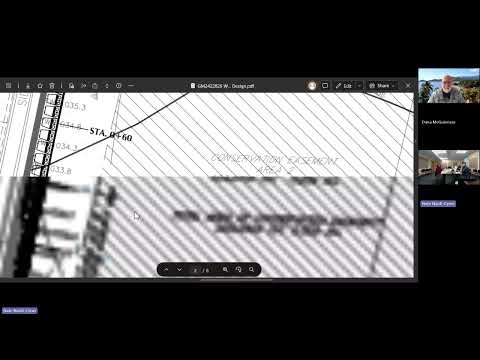
The Torrington Conservation Commission on March 24 reviewed plans to stabilize a failing modular-block retaining wall at the Torrington Fair/Walmart Plaza entrance and directed staff to send a letter stating the commission found no direct impact to the adjacent conservation easement.
Ken, the project presenter, described a plan to install freestanding, large modular-concrete blocks in front of the existing wall rather than removing and replacing the older structure. He said the existing geogrid — a reinforced-plastic matting behind the original face — continues to stabilize soil and that the new 5-foot-deep blocks will be set on a leveling pad so the contractor can avoid large excavations behind the roadway. “It’s not an imminent danger of collapsing,” Ken said of the current condition, but he added the aging concrete is deteriorating and the new wall would protect the original structure when it begins to fail.
Commission members focused on protecting the adjacent conservation easement and wetlands during construction. Ken said the team will stake and physically mark the easement boundary with a cored-log erosion-and-sediment-control barrier set and staked by a licensed surveyor before work begins. He described methods to set most blocks from the roadway using a long‑reach excavator to minimize disturbance within the buffer.
After questions about geogrid extent, plantable topsoil depth and the need for a small excavator to install a gravel leveling pad, the commission voted to instruct staff to prepare a letter for permitting authorities stating the commission had reviewed the application and had no objection, so long as erosion-control markers were installed at the easement edge and stockpile/clearing limits were respected.
The motion to authorize that letter was seconded and carried. The commission emphasized that wetlands and inland‑wetlands review remain separate processes and that any contractor activity observed inside the easement should be reported to staff for remediation.