Get AI Briefings, Transcripts & Alerts on Local & National Government Meetings — Forever.
Consultants: Minnesota State fundraising is ‘emerging’; recommend staffing, shared services and systemwide priorities
Loading...
Summary
Phoenix Philanthropy Group told trustees that most Minnesota State campuses fall in an "emerging" fundraising category and recommended peer group staffing, shared services (prospect research, planned giving), and systemwide priority areas (Equity2030, workforce/regional partnerships) to scale philanthropic revenue over a multi‑year effort.
Consultants from Phoenix Philanthropy Group reported a phase‑one internal assessment to the Outreach & Engagement committee, concluding that nearly all Minnesota State colleges and many universities currently fall into an "emerging" category for fundraising capacity and performance. The consultants recommended a mix of institution‑level capacity building and system‑level shared services to grow philanthropic support.
Phoenix outlined a set of possible models—from governance and limited shared support to partial or full centralization and a scale/efficiency approach—and said recommendations would blend elements of those models tailored to Minnesota State. "Nearly all Minnesota state colleges and universities we would classify in this emerging category," one Phoenix consultant said, noting that most local teams are small, wear multiple hats and would benefit from additional frontline fundraisers and better prospect/search tools.
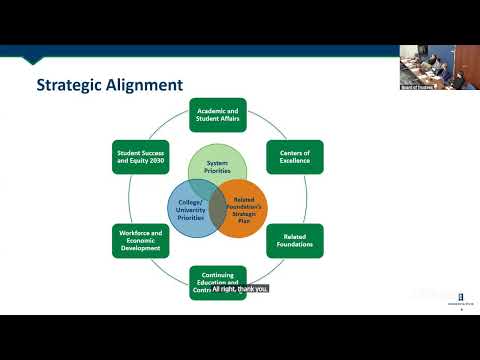
Consultants recommended three priority areas: strengthening strategic alignment between campuses and foundations (so philanthropy supports system priorities such as Equity2030), building staffing/capacity (peer groupings with example staffing ladders: small foundations ~1–1.5 FTE; growing programs ~3.5 FTE; campaign‑ready programs ~9+ FTE), and creating shared services (prospect research, planned‑giving support, vendor pools for auditing or accounting, and master contracts).
Phoenix and the internal foundations work group highlighted candidate systemwide fundraising themes likely to attract external donors: Equity2030 and student success initiatives, workforce and regional economic development partnerships, and centers of excellence that link academics and industry. Consultants flagged that fundraising is a multi‑year process: Phoenix said capacity building often follows a three‑to‑five‑year trajectory, with some infrastructure and shared services scalable and available sooner.
The committee’s work group also urged careful engagement of related foundation boards and suggested pilots for shared services, adding that smaller related foundations frequently need help with basic functions (accounting/audits, donor records) before they can scale major‑gift activity. System staff described existing tools to support the work: a grants prospecting/management contract (Instrumentl), a system IRB for light research, and a planned third leg of the grant‑support suite for grant‑writing assistance.
Presidents and trustees welcomed the recommendations but emphasized resource constraints: presidents asked whether capacity building would be funded from scarce campus resources or via external capacity‑building grants; trustees asked for competitive benchmarking and a timeline and suggested system‑level pilot initiatives that would demonstrate near‑term results. Phoenix will complete an external feasibility phase and return recommendations at the June board meeting.
Representative quote: Phoenix consultants said that "for every dollar invested in fundraising, the standard return is $5," used to illustrate the investment case for staffing and shared services.
What’s next: Phoenix will finish the external interviews and prospects research and will present phase‑two feasibility findings and recommendations at the June board meeting; the board will consider whether to invest system resources or pursue external capacity‑building funding to pilot recommended models.