Get AI Briefings, Transcripts & Alerts on Local & National Government Meetings — Forever.
Committee hears support and privacy concerns for bill to create Missouri Geospatial Advisory Council
Loading...
Summary
At a legislative committee hearing, supporters said Senate Bill 959 would coordinate statewide geospatial data to improve NextGen 911, broadband mapping and economic development; a public commenter called the measure "big brother," raising privacy concerns. The committee took no vote on SB 959.
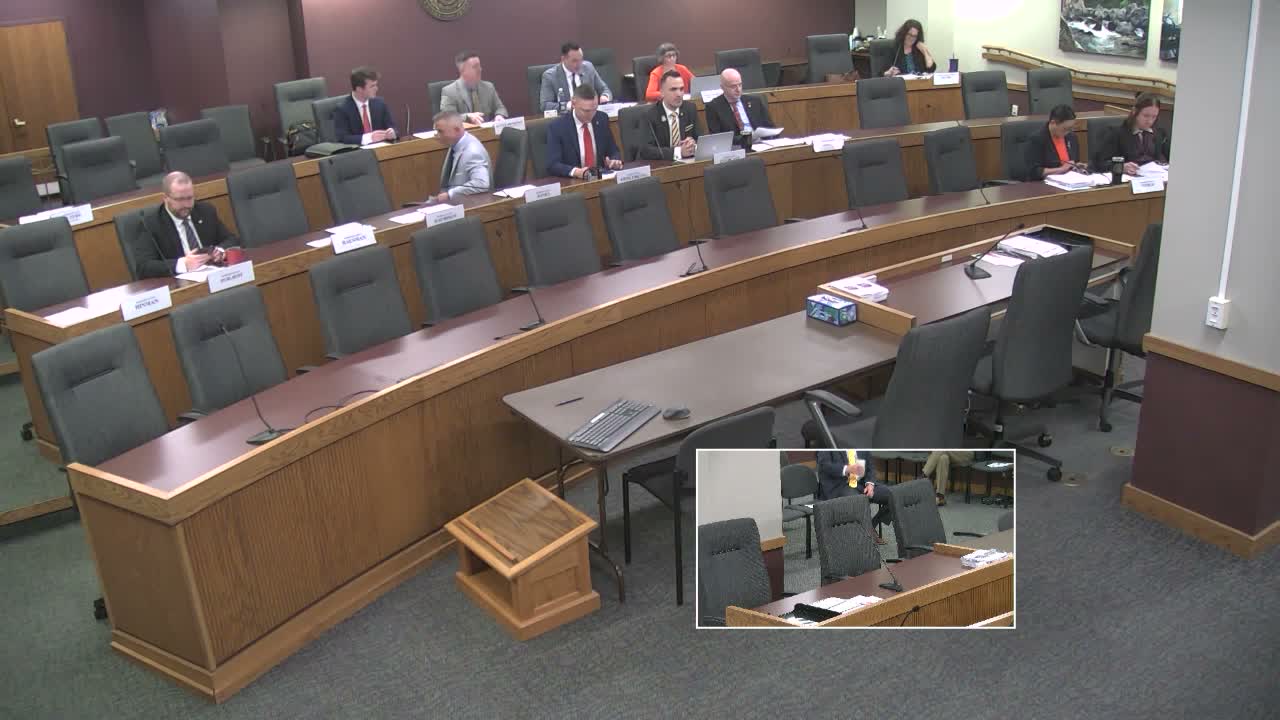
A legislative committee held a public hearing on Senate Bill 959 on behalf of Senator Steve Roberts, with Senator Doug Beck presenting while Roberts serves on active‑duty military orders. Beck summarized the bill as a measure to establish the Missouri Geospatial Advisory Council within the Office of Administration to better coordinate statewide geospatial data for planning, emergency response and broadband mapping.
"This bill establishes the Missouri GIS Council within the office of administration," Senator Doug Beck said, saying the council would "enhance our statewide geospatial data infrastructure through research, planning, training, and education." Beck told the committee the current draft carries no fiscal note and that similar councils exist in other states.
Supporters said improved geospatial coordination can aid emergency responders, economic development and local government planning. Tim Brinker, senior director of policy at Greater St. Louis Inc., told the committee that "better data coordination leads to better decision making across state and local governments," adding that accessible, standards‑based maps help site selection, reduce uncertainty for businesses and improve public services.
Scott Penman of the State 911 Service Board described operational benefits for 911, saying more accurate base maps help dispatchers locate callers and route emergency vehicles. Penman said the state has used aerial imagery projects to increase mapping resolution to useful levels for response, describing "12‑inch data" as a practical level for many emergency uses and saying coordination saved the state an estimated "about $200,000 to $400,000" by avoiding duplicate spending.
Supporters repeatedly emphasized that the bill includes a ban on collecting personally identifiable information. "There's nothing in the bill that allows that. It explicitly prohibits that," Penman said, describing the measure as a way to make publicly funded maps available rather than a system for tracking individuals.
Not all witnesses agreed. A witness who identified herself as Lisa Penette with Armour Vine opposed the bill, calling it "completely big brother" and saying language that aims for "immediate access to statewide geospatial data for all citizens" risks enabling government or third‑party tracking. "They want to know where we are at all times," she said, and cited previous filibusters as an explanation for the bill's past difficulties in becoming law.
Committee members pressed both sides on specifics: Representative Price and others asked whether the bill's data differs meaningfully from data held by private cellphone providers, and whether rural areas without 911 addressing would benefit. Supporters replied that the bill focuses on base maps and location infrastructure rather than on records tied to individual identities, and that better mapping improves emergency response in rural routes that currently lack precise 911 addresses.
Sarah Schleemeyer, representing BioSTL and Next Missouri, said geospatial infrastructure is increasingly a factor in business location decisions and urged the committee to consider competitiveness benefits.
The committee closed the public hearing without taking a vote on SB 959 during this session. Earlier in the meeting the panel voted that Senate Bill 905 be given a "due pass," recording a committee tally of 6 ayes and 4 nays.
The hearing record for SB 959 was concluded in this session; witnesses filed supporting forms and the bill will proceed through the Legislature according to committee rules.