Get Full Government Meeting Transcripts, Videos, & Alerts Forever!
Get email alerts on the Sidewalk Funding And Inventory topic
No spam. Unsubscribe anytime.
Spokane town hall lays out sidewalk inventory, accessibility gaps and four state funding options
Summary
City staff presented a new, block‑level sidewalk inventory and curb‑ramp audit and described four state‑level funding mechanisms under study; residents pressed officials about affordability, notification, micromobility obstructions and a narrowly sited development that would add an isolated sidewalk.
At an evening town hall in Spokane, city officials presented a new sidewalk inventory and detailed potential funding models for repairing and completing the city’s sidewalks.
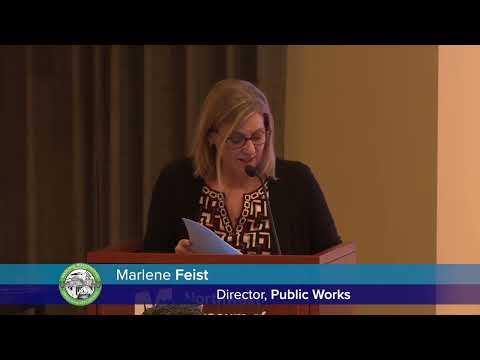
Arlene Feist, director of public works, said a recent data project scoping and condition scans show the scale of the problem: “We had about 860 miles of existing sidewalk on the local streets and another 337 miles on arterial streets,” and the city identified roughly “422 miles of missing sidewalk on the residential system and a 121 miles of missing sidewalk on the arterial system.” She told attendees the city also cataloged curb ramps and found about 10,200 with truncated domes, 2,000 without domes and roughly 16,000 corners with no ramp.
Those numbers, Feist said, come from a 2024 council‑authorized project that contracted TransMap to validate sidewalk presence and used scans from DeepWalk this summer; interns scoped about 860 miles between June and October and staff are integrating imagery and attributes into GIS to prioritize work.
The inventory, officials said, is meant to inform a program that balances safety, ADA compliance and long‑term cost. Feist noted crews currently install roughly 75–85 curb ramps a year on arterial projects at an annual cost she put at about $1,000,000, and 50–70 ramps on local streets at a roughly $500,000–$750,000 annual cost.
Code enforcement and repair rules
Luis Garcia, director of code enforcement, explained the city’s enforcement framework and a recently adopted public rule that allows certain minor repairs by adjacent owners without the prior use of licensed, bonded contractors. Garcia said the municipal code places primary maintenance responsibility on adjacent property owners (a paraphrase of the cited RCW), but the city is a partner in the public right‑of‑way dedication and will intervene in safety‑sensitive situations. For routine deficiencies the city relies on complaint intake via 311: courtesy notice, a notice of violation and then potential civil enforcement only if compliance does not follow.
On repairs residents can do themselves, Garcia said, “Grinding for the raised panels, replacement of short segments of sidewalk, are all allowed under the public rule.” He added a practical threshold: about a half‑inch elevation change is a candidate for grinding rather than full replacement.
Funding options under study
John Snyder, director of transportation and sustainability, summarized a forthcoming Joint Transportation Committee (JTC) report that examines alternative sidewalk funding models. Snyder compared current local sources and offered preliminary estimates: Spokane’s photo enforcement revenue (school speed and red‑light cameras) brings about $3.2 million a year; the car‑tab road fund (10% currently directed to sidewalks) yields roughly $3.3 million a year. The JTC study examines four state‑level mechanisms that cities could use if state law permits: a per‑parcel sidewalk utility (estimated $4M–$16M/year depending on design), a modified transportation benefit district via a sales tax (roughly $7M/yr estimate in the study), a new real‑estate excise tax (REET) option (also estimated in a multi‑million range, but requiring county action), and a modified stormwater utility fee (numbers to be provided in the final report).
Snyder cautioned none of those strategies can be adopted by the city alone without state authorization; the JTC report will include feasibility, equity and implementation details and is expected later this year.
Residents press on costs, equity and enforcement
Throughout the Q&A residents raised affordability and equity concerns. A District 3 resident, Brian Bell, described a neighbor who uses a wheelchair and said the city’s assertion that adjacent owners are responsible left homeowners feeling uninformed and overburdened. Another attendee asked whether Lime scooters and bike‑share devices should be charged when they block sidewalks; council members said the existing Lime contract currently raises modest revenue (about $250,000/year) and staff are pursuing contract changes and technology to reduce sidewalk obstruction.
On equity, a speaker recounted a targeted‑universalism approach cities have used to spread maintenance work rather than basing service on who calls 311. Staff said urban forestry has a short‑term grant to assist maintenance but that longer‑term funding and programmatic equity remain topics under consideration.
What’s next
City staff said they will continue processing GIS and scan data, return to council later in the year with a program proposal informed by the JTC report, and asked residents to sign up for updates. For immediate safety or localized defects officials reiterated that residents should report issues to 311 with photos so crews can assess and schedule repairs.