Get Full Government Meeting Transcripts, Videos, & Alerts Forever!
Get email alerts on the Baseball Stadium topic
No spam. Unsubscribe anytime.
Council hears schedule and financing outline for proposed downtown minor-league ballpark; staff says bonds contingent on development milestones
Summary
Staff briefed council on a proposed downtown minor-league ballpark (target opening 2028), a financing plan that pairs team equity with tax-increment/assessment-backed bonds and guarantees for phases 1–2 of mixed-use development; council sought more detail on relocation funds, guarantees and community benefits.
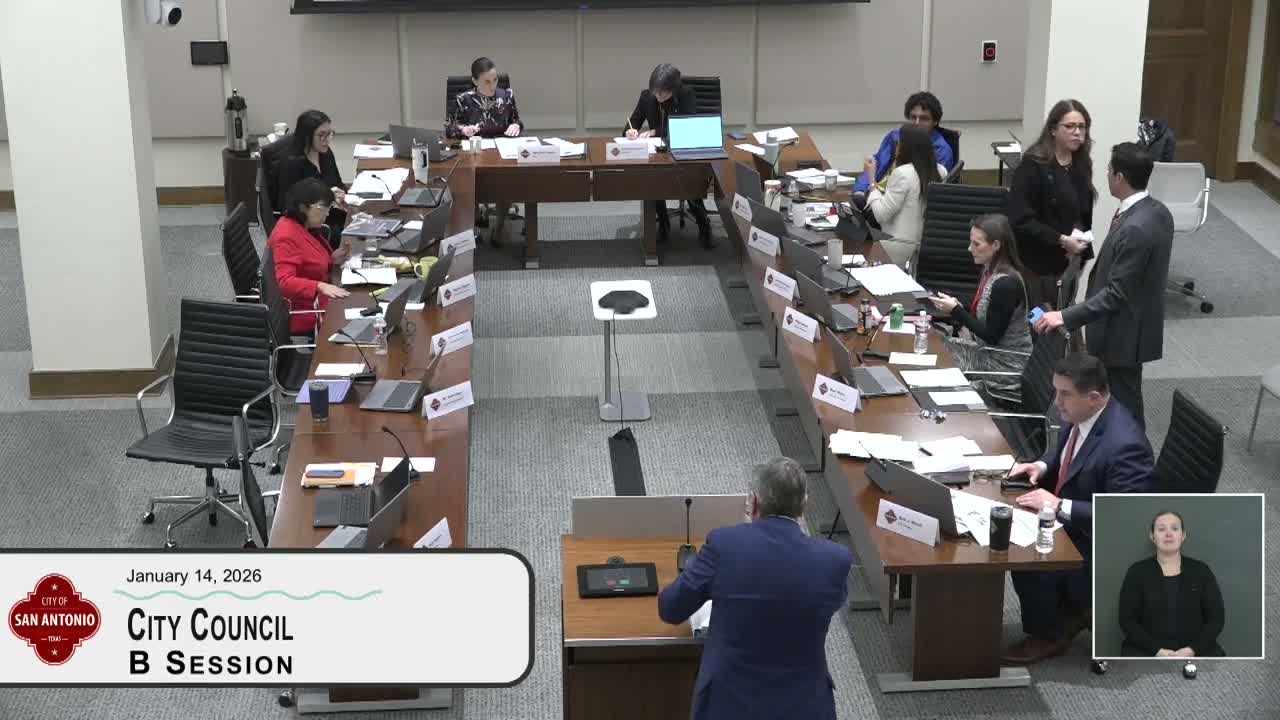
City staff provided a detailed update Wednesday on a proposed downtown minor-league baseball stadium and associated mixed-use development, emphasizing conditions that must be met before the city would approve bond financing.
Ben said the ballpark concept calls for roughly 4,500 fixed seats (about 7,500 total capacity) with an initial estimated cost of $160,000,000 funded by a combination of team equity, bond proceeds backed by incremental taxable value in the Houston Street TIRZ and a municipal management district assessment. "The ballpark would open April 2028," Ben said, while noting that the schedule depends on design, guaranteed phases and bond-market conditions.
The financing structure described by staff relies on developer guarantees for phases 1 and 2 of the mixed-use development; those two phases are "guaranteed" under the term sheet and must reach certain milestones—phase 1 must be ready to proceed and phase 2 must be under design—before the city will move to issue the related revenue bonds. Ben told the council the team would also provide lines of credit as security that decrease as taxable value is realized.
Community and operational elements: The term sheet includes community-benefit commitments, such as free-ticket allocations for youth organizations, stakeholder advertising days for city and county, local-participation goals for contractors and a foundation contribution that staff characterized as at least $200,000 annually to support youth and veterans programs. Staff also presented a relocation plan for tenants affected by the developer's phased buildout and said about $274,000 remains available for relocation assistance for later phases.
Council questions and outstanding items: Council members pressed staff on several points: the mechanics for the city’s $500,000 annual contribution to a ballpark capital-improvement fund (matched with $250,000 from the team), the definition of the developer guarantees and what would trigger reimbursement, the precise breakdown of relocation payments to tenants, and how cost overruns will be treated when GMPs are set. Ben said the team would be responsible for construction overruns once a guaranteed maximum price is established and that staff will return with feasibility reports and updated cost estimates as design advances.
Next steps: Staff expects to engage a team-funded bond feasibility consultant in February, produce a draft feasibility report in April and finalize documents, negotiations and potential bond approvals by late spring if phase conditions are met. If agreements are approved in June, staff said the city could move quickly to market; the team remains responsible for meeting the design and financing conditions that underpin issuance of revenue bonds.