Get Full Government Meeting Transcripts, Videos, & Alerts Forever!
Get email alerts on the Downtown District topic
No spam. Unsubscribe anytime.
City staff lays out 2026 work plan for downtown sports-and-entertainment district, seeks council input on engagement and sequencing
Summary
City staff presented a multi-pronged 2026 work plan for the proposed Downtown Sports & Entertainment District, including a $30M offer for three federal parcels, planning grants for connectivity, and consultant studies on services, parking and financing; council members pressed for clear community engagement, timelines and accountability measures.
City officials on Wednesday outlined a multi-year work plan for a proposed Downtown Sports and Entertainment District that pairs expansion of civic venues with major infrastructure and development projects.
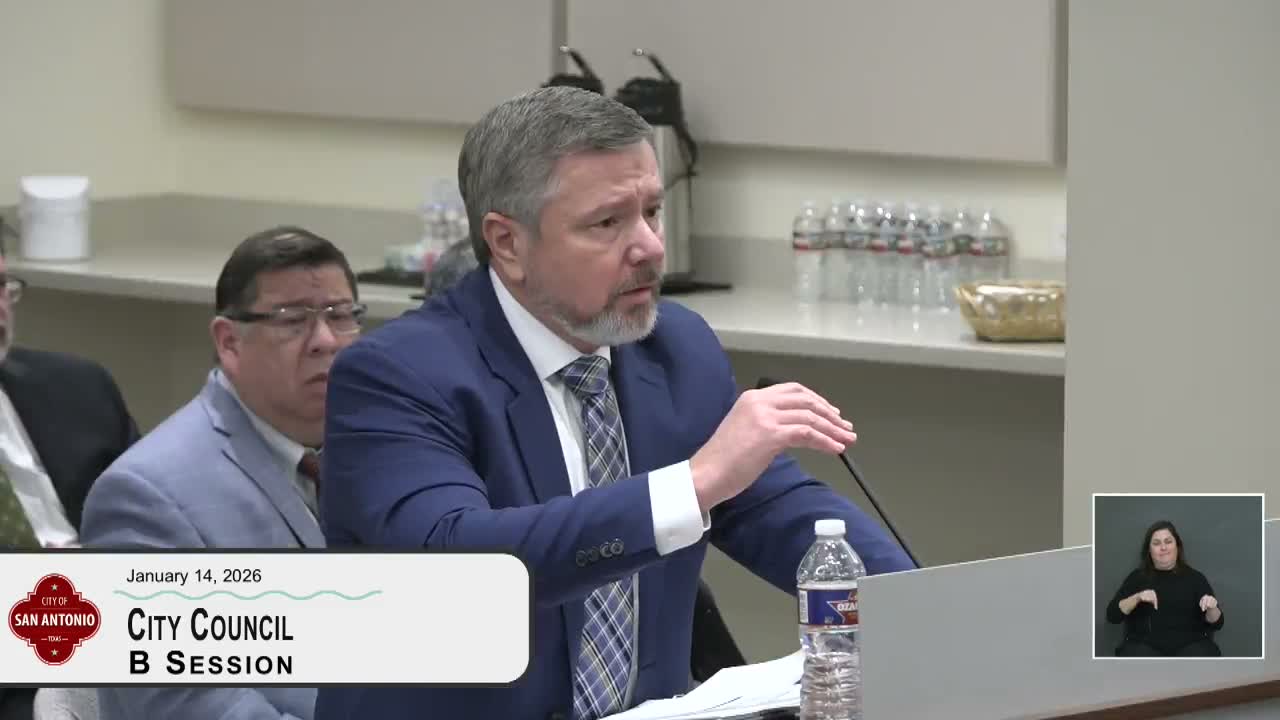
Ben, a city project lead, told the council the immediate priorities include an offer to acquire three federal parcels east of the Wood Courthouse (about 5.7 acres) for $30,000,000, work on a neighborhood-access grant for better connectivity across IH-37, and multiple consultant studies on district services, parking and finance. "We are proposing an offer of $30,000,000. That is based on an appraisal that we did on the property," Ben said, noting the GSA requested the city submit an offer by Jan. 26.
The offer would be accompanied by a contingency deed tied to the arena project: Spurs funding would cover earnest money and up to $30,000,000 of acquisition costs now, and if the arena project does not proceed the city would have the option to reimburse the Spurs or transfer title under the contingency terms. Eric, a senior staffer, asked the council for guidance on the frequency of public updates and said staff planned a regular tempo of briefings and, when needed, executive-session updates during negotiations.
Why it matters: Staff framed the package as an integrated set of projects that will affect transit, public safety costs and long-term revenue. Several council members pushed back that some work could begin now and that community engagement should be front-loaded. "The number 1 thing we've got to look at is parking," Councilwoman Core said, urging the city to prioritize a platform that exposes public parking availability and to step up enforcement in neighborhoods.
What staff plans to do next: The city plans to release an RFP for a district study (cost-of-services, general-fund impacts and new revenue opportunities) and an RFQ for an executive program manager (EPM) to coordinate projects. Ben said the EPM placeholder is $10,000,000 for initial program management and that much of the EPM cost would be charged back to individual project budgets. Staff also noted a USDOT Neighborhood Access and Equity grant of about $3.0M plus a $740,000 local match (total ~$3.7M) that must be spent by Dec. 31 and could fund early connectivity work.
Key open issues and council direction: Council members emphasized affordable housing, transportation options beyond adding garage capacity, strengthening local-hiring and contractor goals, and building a public-facing accountability dashboard. Several members asked staff to ensure that definitive negotiation documents (community benefits agreements, development agreements and bond documents) return to council with ample time for review and public engagement.
Next steps: Staff will present discrete procurement items (RFPs/RFQs) to the audit committee and council in the coming weeks, begin the district study and related procurements, and return with recommended consultant selections and more-detailed timelines, including a proposed approach to community engagement and a schedule for executive-session briefings when negotiations warrant.