Get AI Briefings, Transcripts & Alerts on Local & National Government Meetings — Forever.
Committee rejects transfer of CWD rulemaking to agriculture department after expert testimony
Loading...
Summary
After expert testimony on genomic selection for chronic wasting disease (CWD), the committee voted 3–9 to reject House Bill 3,270, which would have given the Department of Agriculture sole rulemaking authority for a deer-release/genetic-upgrade program. The hearing featured contrasting views between the bill’s sponsor, an academic researcher, and the Department of Wildlife Conservation.
Senators on the ad committee declined to move House Bill 3,270 forward after a daylong hearing that included detailed scientific testimony on genomic prediction for chronic wasting disease in farmed deer.
Dr. Chris Seaberry, a tenured professor at the Texas A&M College of Veterinary Medicine, told the committee his team’s genomic models can predict CWD susceptibility with high accuracy. “We were able to actually predict the incidence of the disease with 82 percent accuracy,” Seaberry said, citing cross-validation and a blind APHIS sample in which his method flagged roughly 118 of 136 known positives. He described a statistical cutoff (near –0.056) and said animals with strongly negative breeding values and the 96 SS genotype in his dataset had test-positive rates near zero.
Seaberry said his group has used the same genomic-selection methods applied in cattle and other livestock, and that a combination of genetic selection and management practices had eliminated detectable infection at multiple depopulated farm sites. He cautioned, however, that improper live-testing procedures — for example, reusing biopsy tools without thorough disinfection — could create the appearance of on-farm spread. “With a tonsil tool that cost $600 and they cannot be used as disposable…You’re gonna get a disease outbreak. That is what happened,” he said.
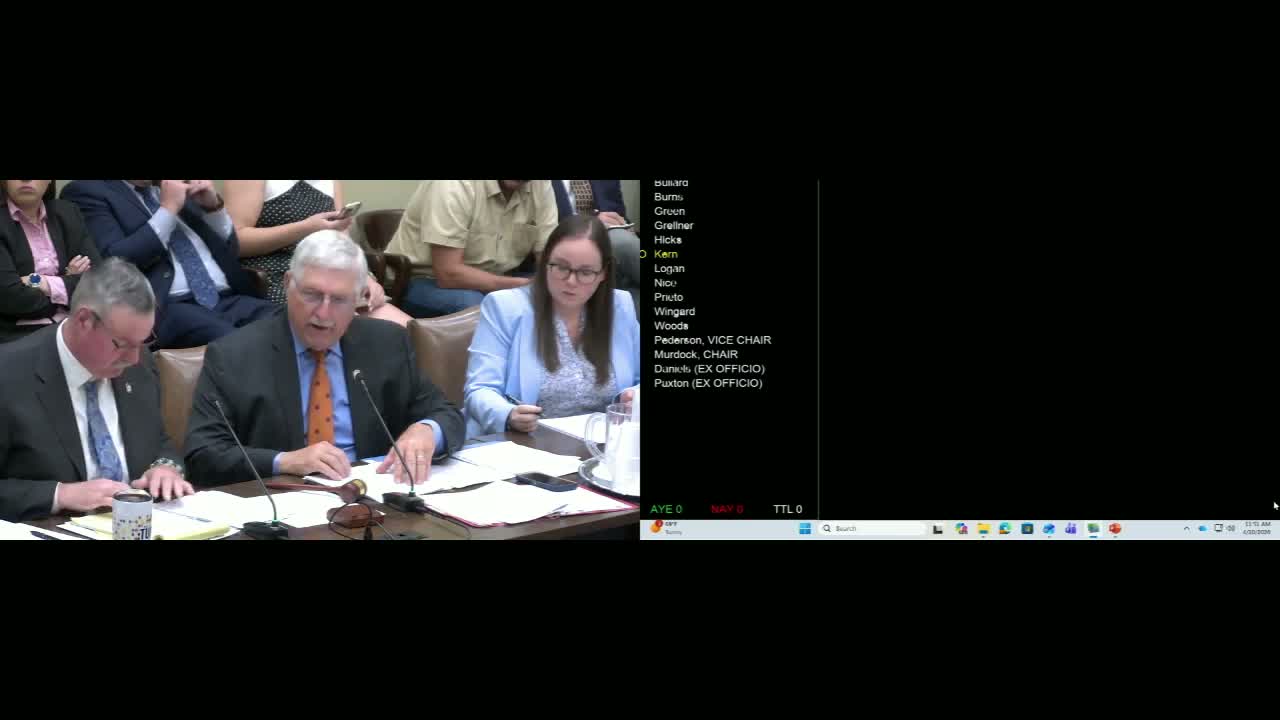
Proponents of the bill — including the bill’s sponsor, Senator Murdock — argued the law passed two years ago allowing limited releases into the wild needs implementing rules and accused the Oklahoma Department of Wildlife Conservation of failing to carry out its statutory duties. “When you have a state agency that does not want to do what this building told them to do in law…that’s what’s offensive,” Murdock said, urging the committee to transfer rulemaking authority to the Department of Agriculture.
The Department of Wildlife Conservation’s assistant director, Nels Rodefeld, told senators the agency had collected and turned in native-deer samples (about 550 the first season and another 550 recently) and that an Attorney General opinion issued March 5, 2026 changed the agency’s legal interpretation of how conditional pilot approvals could work. “It was legal to release deer,” Rodefeld said, summarizing the opinion’s effect and explaining why the commission had not finalized rulemaking immediately.
Several senators expressed caution about moving ahead without more data on the wild population and long-term ecological risks. Others framed the vote as a response to what they viewed as agency inaction. After debate and a roll call, the committee recorded 3 ayes and 9 nays and declared House Bill 3,270 failed.
What’s next: With the bill defeated in committee, its author said agencies had had two years to promulgate rules and that the matter could return to the Legislature if the department does not act; agency officials said they will continue to gather data and consider rulemaking options under the AG opinion’s guidance.