Get Full Government Meeting Transcripts, Videos, & Alerts Forever!
Get email alerts on the Energy topic
No spam. Unsubscribe anytime.
City staff brief council on Climate Commitment Act, possible six‑figure to million‑dollar compliance costs
Summary
City Administrator Chris Searcy briefed the council on the Washington Climate Commitment Act, saying the municipal gas utility is marginally over the 25,000 metric‑ton threshold that triggers coverage; staff estimated first‑year compliance costs around $250,000 rising in later years and described options including reducing load, pursuing alternative compliance approaches with Ellensburg, or legislative remedies.
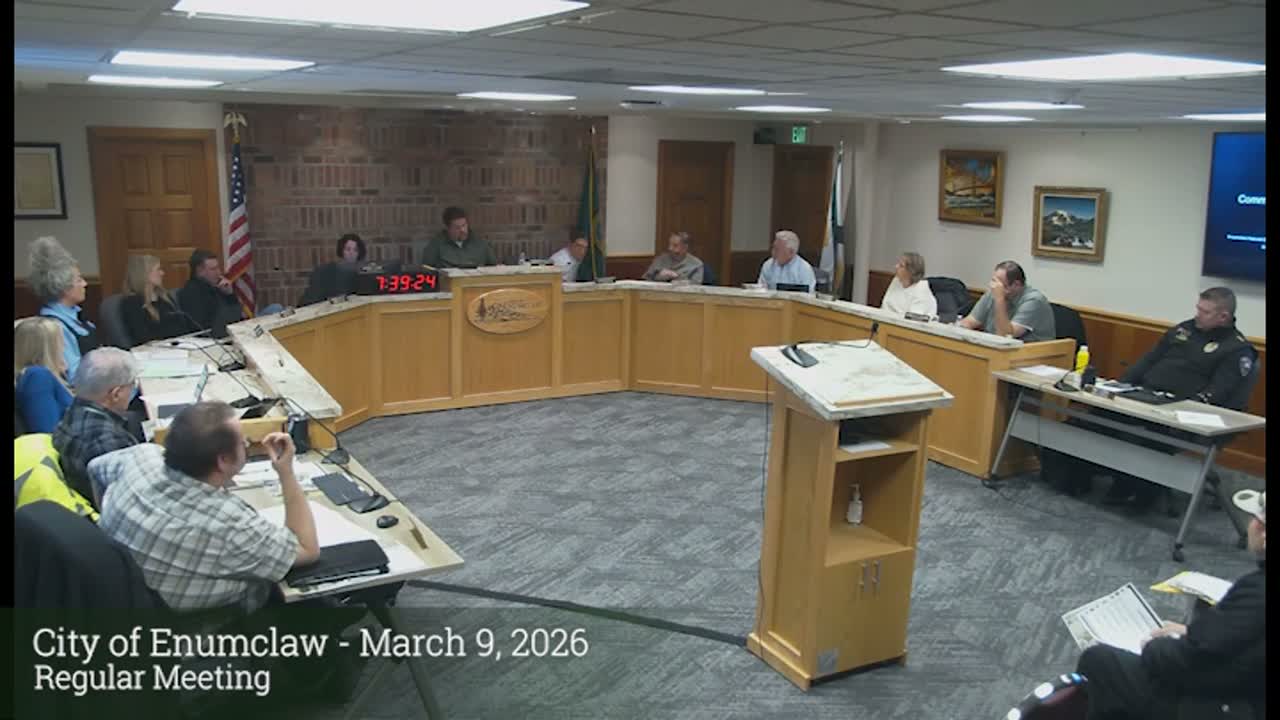
Uniontown — City Administrator Chris Searcy gave a detailed workshop to council on the Washington Climate Commitment Act (CCA), explaining how the cap‑and‑invest program applies to covered entities and what it means for Uniontown’s municipal natural‑gas utility.
Searcy summarized the program’s mechanics (annual carbon allowances, quarterly auctions, and the state’s phased reduction of no‑cost allowances). He said the city’s average emissions for 2023–2025 were “a little over 25,000 metric tons,” placing the utility just over the statutory threshold for coverage. "We are just marginally over the threshold of being pulled into the program," Searcy said.
Staff explained how the city currently uses auction proceeds and allowances to offset customer bill impacts and described two customer classes used in city billing: “legacy” customers (connected before July 25, 2021) who receive some auction‑proceeds offset, and “non‑legacy” customers who pay the full compliance cost. Searcy said legacy customers have seen a CCA charge near 6–7¢ per CCF historically while non‑legacy customers initially saw an estimated 23¢ per CCF.
Financial context: Searcy said the first‑year compliance cost for the city was about $250,000 (2023) and rose toward $400,000 more recently; he said compliance costs could exceed $1,000,000 annually in future years depending on carbon prices and market linkage. He emphasized uncertainty: the state’s greenhouse‑gas reporting is overdue and the potential linkage to other cap markets (such as California) could materially change allowance prices.
Policy choices and next steps: Searcy outlined options for council direction, including programs to reduce gas load (customer electrification and heat‑pump incentives), pursuing full cost recovery for new developments, and working with Ellensburg and other municipal utilities on an alternative compliance approach or a restricted account model. He recommended council consider the topic further, gather more information and return to the issue in May.
Public reaction and council next steps: Council members asked for clearer ballpark figures; staff said they would provide more detailed projections and recommended returning with a refined budget forecast and potential grant or legislative strategies. The council agreed to revisit the CCA item in May.
Why it matters: For municipal gas utilities that cross the CCA threshold, the program can add recurring compliance costs to the utility and customers. The council’s future policy choices could affect rate structure, development practices and city budgeting for decarbonization programs.
Quoted: "It is the law. We must comply with it," Searcy said. "The goal for us would be to get below 22,500 (metric tons) or that 10 percent buffer below 25,000."