Get Full Government Meeting Transcripts, Videos, & Alerts Forever!
Get email alerts on the Education Technology topic
No spam. Unsubscribe anytime.
Oak Grove presents community‑developed AI framework to guide student and staff use of generative tools
Summary
The Oak Grove School District Board heard a presentation on a six‑part AI framework developed by a 34‑member task force and advisory committee, prioritizing AI literacy, student privacy and 'walled‑garden' implementations for classroom use; staff recommended training and policy updates and said no district‑wide AI tool has been formally adopted yet.
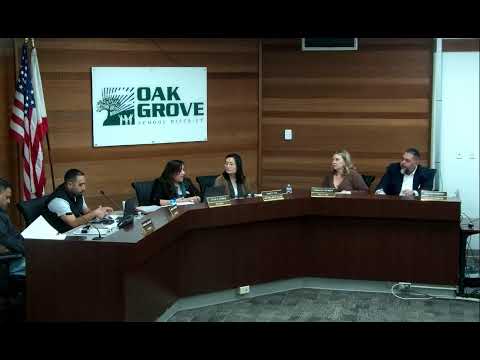
Oak Grove School District officials on Jan. 15 presented a community‑developed framework to guide the use of artificial intelligence in classrooms, stressing student privacy and staff training before districtwide adoption.
Assistant Superintendent Anna and members of the district EdTech team described a three‑year process that produced a six‑part guidance document covering AI literacy, integration, ethical considerations, safety, security and privacy. Anna said the framework was developed with input from 34 task‑force members, an advisory committee and broader community feedback including parents, staff and students.
"For the past three years, the EdTech specialists and I have been working together to understand the landscape of AI and education and engage in a process that will guide our community as we navigate this technology," Anna said, introducing the task force and the framework.
Steve Harmon and Bruce Neff of the EdTech team reviewed the task force’s methods: a combination of small‑group work, surveys, artifacts such as gallery walks, and repeated drafts that were circulated to advisory reviewers. Harmon's presentation emphasized that the framework aims to "amplify and not replace human connection and professional judgment," and to be flexible as tools change rapidly.
Sergio Rizzi, an EdTech team member, described practical privacy controls the district plans to require. He said the district favors "walled‑garden" products — tools that operate inside the district’s protected Google Workspace account — over public, consumer‑facing services that feed user inputs back into large language models.
"Anything that you put in [public-facing AI] is fed back into the learning models," Rizzi said, adding that the district checks compliance with the National Student Data Privacy Agreement and the California addendum before approving tools.
Three task‑force members who participated in the presentation — Ashley Walker, a TOSA working with special education teachers; Justin Moller, a Parkview parent and engineer; and Andrea Snyder Wood, a UC Santa Cruz academic advisor and former district student — described why they joined and why a framework matters. Walker said the guidance focuses on how AI can help teachers and students without introducing new risks to vulnerable learners.
Board members asked about grade‑level sequencing for AI literacy, liability and how cell‑phone use might interact with district policy. Trustee Martinez urged deeper instruction about how AI works, not just how to use tools. Anna said staff plan targeted professional development and that the district will monitor state and CSBA policy work before proposing formal board policy updates under existing Student Use of Technology rules.
The presentation included examples of limited, teacher‑driven pilots and a reminder that the district has not adopted any single AI tool for universal classroom use. "We haven't formally adopted an AI‑powered tool for educators and students to use in the classroom," Anna said. "We have had some pilot opportunities and classroom pilots that are in a walled garden."
The board did not take action on the framework at the meeting; staff said policy proposals could be brought to the board in the spring once sample CSBA language and internal recommendations are finalized.