Get Full Government Meeting Transcripts, Videos, & Alerts Forever!
Get email alerts on the Council Consideration Requests topic
No spam. Unsubscribe anytime.
San Antonio mayor proposes CCR verification and early legal review; council members press for ordinance vote
Summary
Mayor Jones asked the City Council to adopt modest procedural 'enhancements' for council consideration requests (CCRs) — an early legal read and a quick city manager acknowledgment — to improve efficiency and reduce legal risk. Several council members said changes that affect city services or existing ordinance should be decided by the full council; no vote was taken.
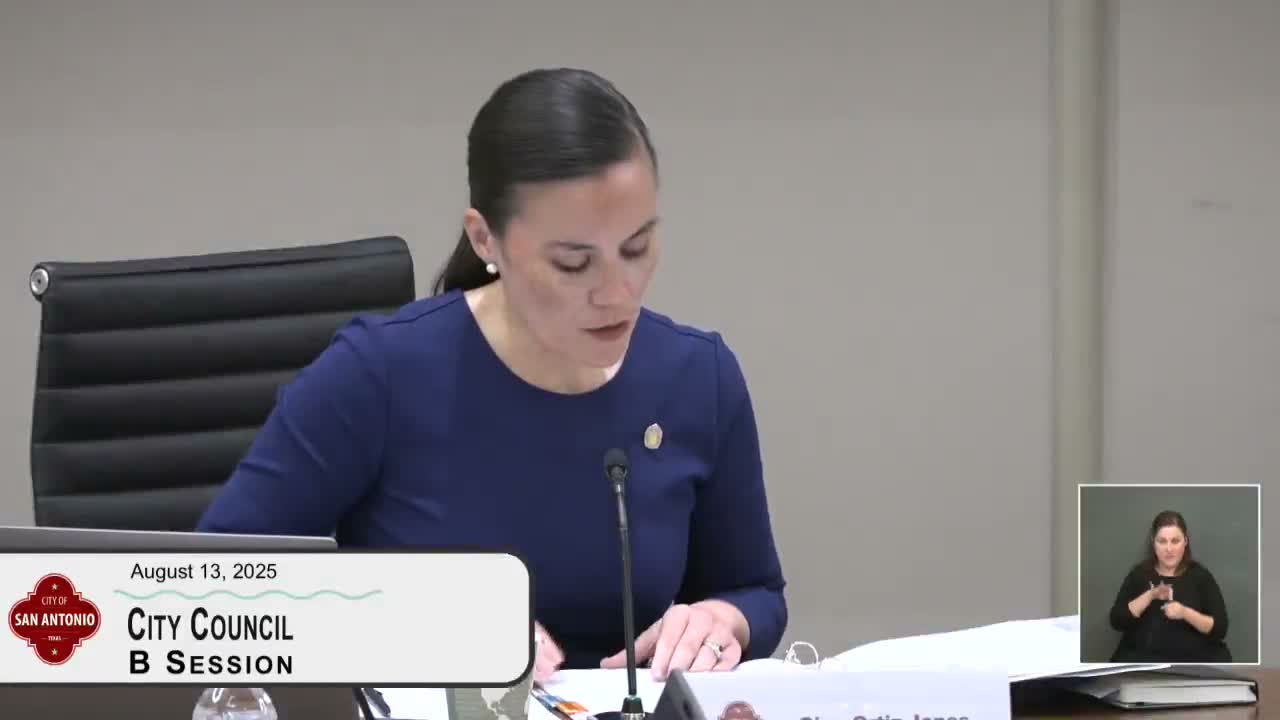
Mayor Jones convened a special San Antonio City Council session on Aug. 13 to outline proposed changes to the council consideration request (CCR) process intended to speed consideration and reduce legal risk.
"These are all about going faster," Mayor Jones said, describing three procedural enhancements: (1) requiring the city manager to acknowledge receipt of a CCR (an initial) so sponsors can verify the notification step actually occurred; (2) asking the city attorney to provide an early, written legal assessment; and (3) asking sponsors to state briefly whether the request affects a core city service to inform FY26 budgeting priorities. "That does not stop anything," Jones said of the proposed steps, framing them as verification and information-sharing rather than a veto on proposals.
City Attorney Andy told the council the changes were "not contradictory to anything in the ordinance" and described them as supplemental to the existing CCR rules. "You had asked whether ... the changes you had made in your memo are legal, and I have said that they are," Andy said, adding his office would document legal concerns in writing if they arise.
Several council members pushed back, saying the memo reaches beyond administrative clarification and treads on the council's prerogative to set its rules. "I prefer to keep the council adopted CCR process in place," Councilwoman Castillo said, arguing CCRs often affect city services and should be amended only by a council vote. Councilman Mark White told the chamber the 2024 ordinance sets the prerequisites for filing a CCR and said the mayor's draft "absolutely conflict[s] with this ordinance," urging that any change be codified through the full council.
Other council members raised practical concerns. Councilwoman Spears said she worried that adding a four-day window for a written legal review could delay constituent requests; she also asked whether coordination with the mayor's office could create a walking quorum. Mayor Jones responded that the memo had removed the mandatory coordination language and that the initial was meant only to confirm the existing notification step had occurred.
Several members defended the CCR process as an essential tool for advancing constituent-driven policy. "We report to the residents," Council member Aldrete Gavito said, adding that staff should not have the power to "veto" ideas and that the council should decide process changes.
Council discussion also addressed a mayoral suggestion that CCRs filed but not completed in the previous term be resubmitted. Some members said re-filing would disrespect work already undertaken and could waste staff resources; others argued that resubmission ensures the new council's consent and the integrity of the current body's agenda.
Operational suggestions came up during debate: Councilwoman Corr proposed an enterprise e-signature (DocuSign) to allow simultaneous electronic acknowledgments from staff, which would speed any required initialing.
The meeting was a briefing and no formal action or vote was taken. Mayor Jones said he would take the feedback under advisement and noted the council attorney had concluded the enhancements are allowable under the current ordinance. The council moved into executive session at 3:50 p.m. to discuss separate legal and property matters and reconvened at 4:25 p.m.; no official action was taken in executive session. The special session was adjourned shortly thereafter.
Ending: The council did not adopt the proposed enhancements at the meeting; members asked for additional discussion and for potential changes to be considered by the full council if they are to be codified as ordinance changes.