Get Full Government Meeting Transcripts, Videos, & Alerts Forever!
Get email alerts on the Climate Commitment Act topic
No spam. Unsubscribe anytime.
City administrator outlines Climate Commitment Act costs, options for municipal gas utility
Summary
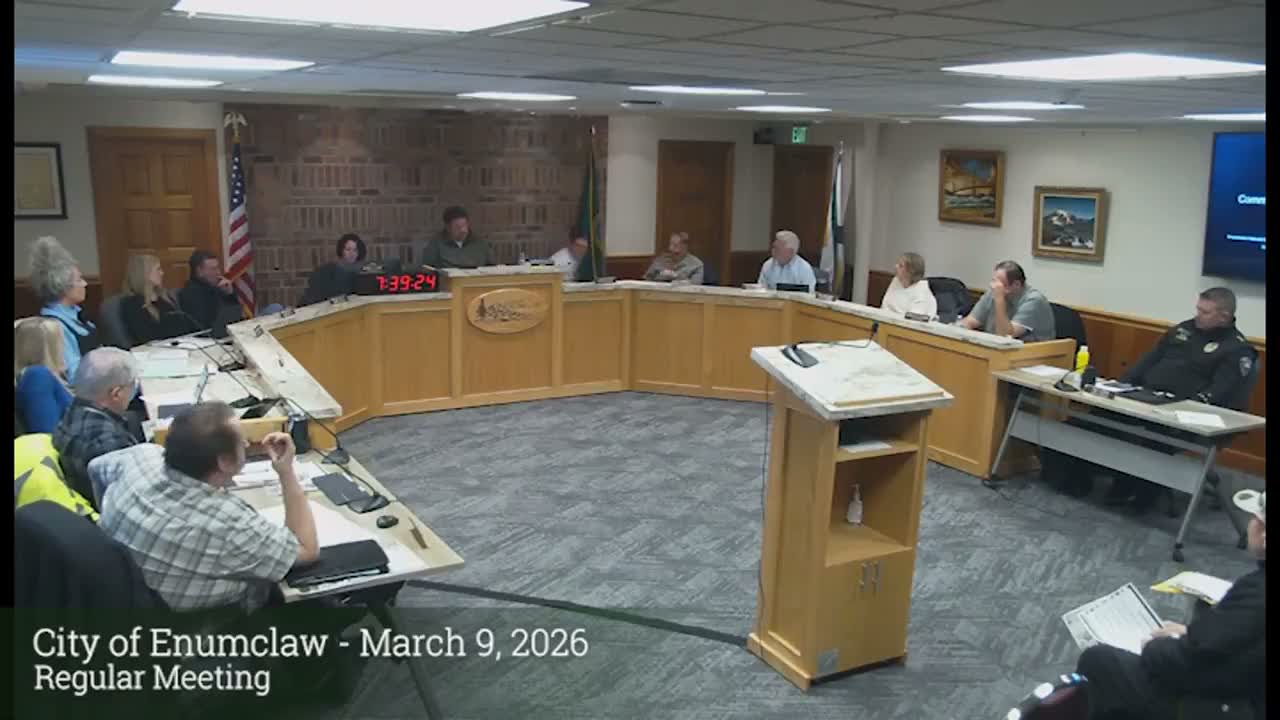
City Administrator Chris Searcy gave a lengthy March 9 workshop explaining how Washington’s Climate Commitment Act affects Uniontown’s municipal gas utility — noting the utility is narrowly over the 25,000‑ton threshold, describing customer bill impacts (legacy vs. non‑legacy), estimating current compliance costs and asking the council for policy guidance and possible legislative collaboration.
City Administrator Chris Searcy told the Uniontown City Council on March 9 that the Climate Commitment Act (CCA) — Washington’s cap‑and‑invest program — is law and that the city’s municipal natural‑gas utility is “just marginally over the threshold” that pulls it into the program.
Searcy said the utility’s average emissions for 2023–25 were a little over 25,000 metric tons, meaning the city must obtain carbon allowances and participate in auctions. “We are just marginally over the threshold of being pulled into the program,” he said, adding that Ecology can keep a covered entity in the program if it remains within 10% of the threshold.
Why it matters: the CCA requires covered entities to acquire allowances equal to their greenhouse‑gas emissions; some allowances are provided at no cost but those no‑cost allocations decline each year while the percentage required to be auctioned rises to 100% by 2030. Searcy explained that auction proceeds can offset bill impacts for legacy customers but non‑legacy customers (those connected after July 25, 2021) do not share in those proceeds and pay the full compliance cost.
Searcy provided a sketch of the financial scale: “The first year was about $250,000 in 2023,” he said, and more recently the cost has been on the order of a few hundred thousand dollars. He cautioned that costs could grow substantially: depending on carbon prices and whether Washington links with other markets, compliance could rise in future years and, under some scenarios, exceed $1,000,000 annually.
The administrator described tools the city already uses — converting some no‑cost allowances into compliance instruments and applying auction proceeds to customer bill mitigation — and said the city tracks the CCA charge on customer bills as a per‑unit fee. He also noted that weather and cold winters drive year‑to‑year variation in gas use and therefore emissions, and that a single cold winter can push the average above the threshold.
Policy choices Searcy asked the council to consider include pursuing full cost recovery for new development, seeking legislative carve‑outs or an alternative compliance path for municipal utilities (an approach Ellensburg has pursued), investing restricted funds for local decarbonization, and budgeting for staff or technical resources to run any customer retrofit or decarbonization program. “We don’t have the resources to have somebody manage whatever kind of program we would have,” he said.
Council discussion focused on projections and potential program costs. Council member McClure asked whether compliance costs could top $1 million in future years; Searcy said it was possible depending on market linkage and price trajectories but emphasized uncertainty and recommended returning to the topic in May after staff provides clearer projections and options for legislative engagement.
Next steps: Searcy recommended the council take a few months to consider options, speak with peers and come back in May for more detailed guidance on whether to pursue alternatives such as legislative relief, grant funding for decarbonization planning, or a restricted‑account approach like Ellensburg’s.