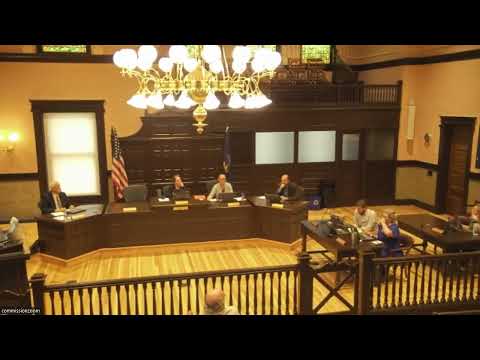
Douglas County approves tenant eviction-defense pilot and authorizes RFP process
Summary
The Board of Douglas County Commissioners voted 3–1 on April 22 to authorize the county administrator to solicit proposals for a tenant eviction defense pilot that staff aims to run June 1–Dec. 31; commissioners emphasized data collection, landlord outreach and a future budget decision for continuation.
The Board of Douglas County Commissioners on April 22 voted to approve a pilot program to provide eviction legal defense services to qualifying tenants and authorized the county administrator to solicit proposals from qualified nonprofit legal service providers.
Jill Jolliker, assistant county administrator, told the board the packet included a combined pilot overview and informal request-for-proposals (RFP) document and that staff hopes “to commence … services being provided, through a referral process by June 1,” with an initial pilot term running from June 1 until Dec. 31. Jolliker said staff will submit a placeholder supplemental request in the 2027 budget process and intends to provide regular updates to the commission on outcomes and lessons learned.
The vote followed questions from commissioners about how the program will measure longer-term outcomes and who will be eligible for full representation. Jolliker said the RFP asks proposers to track outcomes (including up to six months of follow-up where feasible) and that eligibility will be determined mainly by the circumstances of each eviction case rather than by preset income cutoffs.
Public commenters offered mixed views. Jesse Fisher, a property manager, asked whether a recently passed state law—identified in public comment as "Senate Bill 391"—would affect the pilot because it allows landlords to reject third-party payments; county staff later said the bill does not change the pilot’s funding intent. Russ Livingston cautioned that publicly funded legal services can appear one-sided and urged the board to consider impacts on landlords and homeowners; an online commenter, Vince Munoz, urged support for the pilot and noted landlords already receive certain county supports in some cases.
Several commissioners emphasized that the pilot is intended as a modest evidence-gathering exercise. They discussed options for budgeting continuation (for example, setting contingency funds in the 2027 budget) and said engaging landlords to collect feedback on how cases selected for full representation affect local landlords would be part of the evaluation. A commissioner also asked staff to avoid wording that implies the service is without cost to taxpayers; the participant suggested replacing the word “free” with “taxpayer-provided” to make funding explicit.
The motion to approve the pilot and solicit proposals was moved by the chair and seconded by another commissioner; the board approved the motion 3–1 with one commissioner absent. The county administrator will proceed with outreach to potential providers and return recommendations to the board for selection and any contract approvals.
Next steps noted in the meeting include finalizing the informal RFP, coordinating closely with the district court self-help center on intake and data-sharing, and determining whether to set aside contingency funds during the 2027 budget process if the commission wants to continue the program beyond the initial pilot term.
AI generated
The text on this page is AI generated. Summaries, highlights, analysis, and video transcripts are all produced from the original source material.
AI can make mistakes, so if you spot one, and we will fix it for everyone.
Note: the source content is unaltered by us. Any content source we link to, be it a video, an audio recording, or a document, is presented exactly as its publisher released it. That publisher is usually a government body, sometimes an individual official or another organisation.