Get AI Briefings, Transcripts & Alerts on Local & National Government Meetings — Forever.
How data centers cool servers — and why some methods can drain municipal water supplies
Loading...
Summary
DPW&T explained four cooling methods — air-cooled, open-loop evaporative, closed-loop recirculating and direct liquid immersion — and described tradeoffs: air cooling uses more electricity but little municipal water; open-loop evaporative systems use the most water; closed-loop can cut water use but costs more; immersion reduces water use but can introduce PFAS disposal concerns.
Baltimore County DPW&T staff outlined the cooling technologies data centers use and the water‑use tradeoffs that matter for county planning.
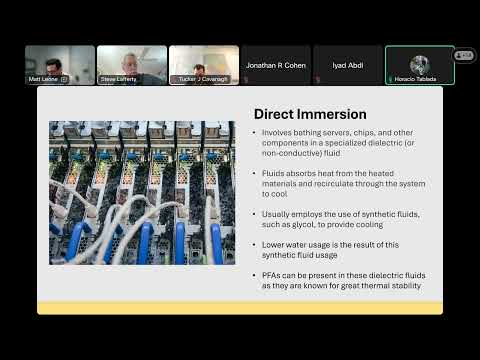
DPW&T described four principal cooling approaches: air‑cooled systems (minimal water use but higher electricity demand); open‑loop evaporative cooling (cooling towers that rely on evaporation and can be water‑intensive); closed‑loop recirculating systems (sealed recirculation that can reduce water use, cited as up to ~70% less than open‑loop); and direct liquid immersion (servers submerged in a dielectric fluid).
"Air cooling ... relative to the other methods ... the water usage is minimal," the presenter said. For open‑loop systems, staff described the evaporative process as the source of high municipal water consumption when used for cooling towers. For closed‑loop systems, the presenter said: "This can reduce water use by 70% compared to those open loop systems," while noting higher installation cost and potentially higher energy use. On direct immersion, staff said these fluids often have strong thermal stability but raised disposal concerns: many synthetic coolants can be PFAS‑based and are "forever chemicals," which creates environmental and disposal implications.
DPW&T emphasized that a site's business model, owner/operator choices and tenant fit affect which cooling method will be used. The county's planners and engineers said those variables make blanket zoning allowances risky and support the case for site‑specific review and early engagement with developers.
Council members asked technical questions about reclaimed water, well water and dual-feed redundancy for facilities; staff said reclaimed or nonpotable industrial water is a viable option and outlined the county's limited reclaimed infrastructure compared with other jurisdictions.