Get Full Government Meeting Transcripts, Videos, & Alerts Forever!
Get email alerts on the Retirement Incentive Srp topic
No spam. Unsubscribe anytime.
Board authorizes pursuit of supplemental retirement plan; leans to 75% benefit offer
Summary
The Palos Verdes Peninsula Unified Board voted 5-0 to authorize a resolution to pursue a districtwide supplemental retirement program and to enter an agreement with PARS to design and administer it. PARS projected ~20% take rate; board signaled preference for a 75% of final-pay offer pending enrollment and backfill analysis.
Sara Dean was elected board president earlier in the meeting and, later in the agenda, the board considered whether to pursue a districtwide supplemental retirement program (SRP) aimed at reducing long‑term staffing costs and creating potential budgetary savings.
PARS consultant Dennis Yu walked the board through two model offers and the mechanics of the program. Yu said the district would offer an incentive expressed as a percentage of an employee’s final pay, describing a 75% offer as the baseline and an 85% offer as a richer alternative. “The benefit level we looked at last month was what we call 75% of final pay,” Yu told the board, and he summarized projected participation and fiscal effects across multiple scenarios.
PARS’ models estimated 387 employees would be eligible and projected roughly 75 participants under the 75% offer (about 20% take rate) and 84 participants under the 85% offer. Yu explained the district’s potential outcome depended heavily on how many retiring positions would be backfilled: if every retiring position were replaced the program could be near break‑even; if a modest share of positions were not backfilled (PARS used a 10% example), the district could realize multi‑year savings. For example, PARS’ conservative scenario showed approximately $2.6 million in savings over a five‑year horizon if roughly 10% of retiring positions were not replaced.
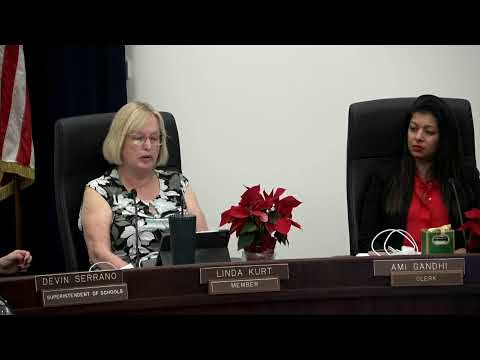
Board members focused questions on risk, the district’s need for particular credentials in some positions, and how backfill and credentialing constraints would affect savings. Several members said they favored a cautious approach. Board member Linda Kurt (outgoing president) and others emphasized concern about losing hard‑to‑replace teachers and staff. Student board members also weighed in on the classroom effects of large retirements.
After discussion the board coalesced around the more conservative option. Multiple board members explicitly stated support for the 75% offer as the most prudent initial path. The board then voted, 5-0, to: (1) adopt a resolution authorizing staff to pursue an SRP and (2) enter into an agreement with PARS to design and administer the program and provide individualized counseling and benefit illustrations to eligible employees. PARS will mail individual benefit illustrations in mid‑December, hold orientations and one‑on‑one counseling in January, and close the election window in February; staff will return to the board with actual enrollment numbers and a fiscal calculation before any payments are made.
What happens next: PARS will deliver individualized illustrations and counsel employees during a 60‑ to 90‑day window; the district will receive final participation counts and a fiscal analysis in late February and will then decide whether to proceed with the program or rescind the offer. The board’s authorization tonight does not obligate the district to pay benefits until members vote to finalize the program after seeing the enrollment and fiscal results.
For transparency, the board asked staff to present clear figures on which positions likely must be backfilled for program implementation and to highlight areas where district credentialing and program needs make backfill unavoidable.