Get Full Government Meeting Transcripts, Videos, & Alerts Forever!
Get email alerts on the Climate Commitment Act topic
No spam. Unsubscribe anytime.
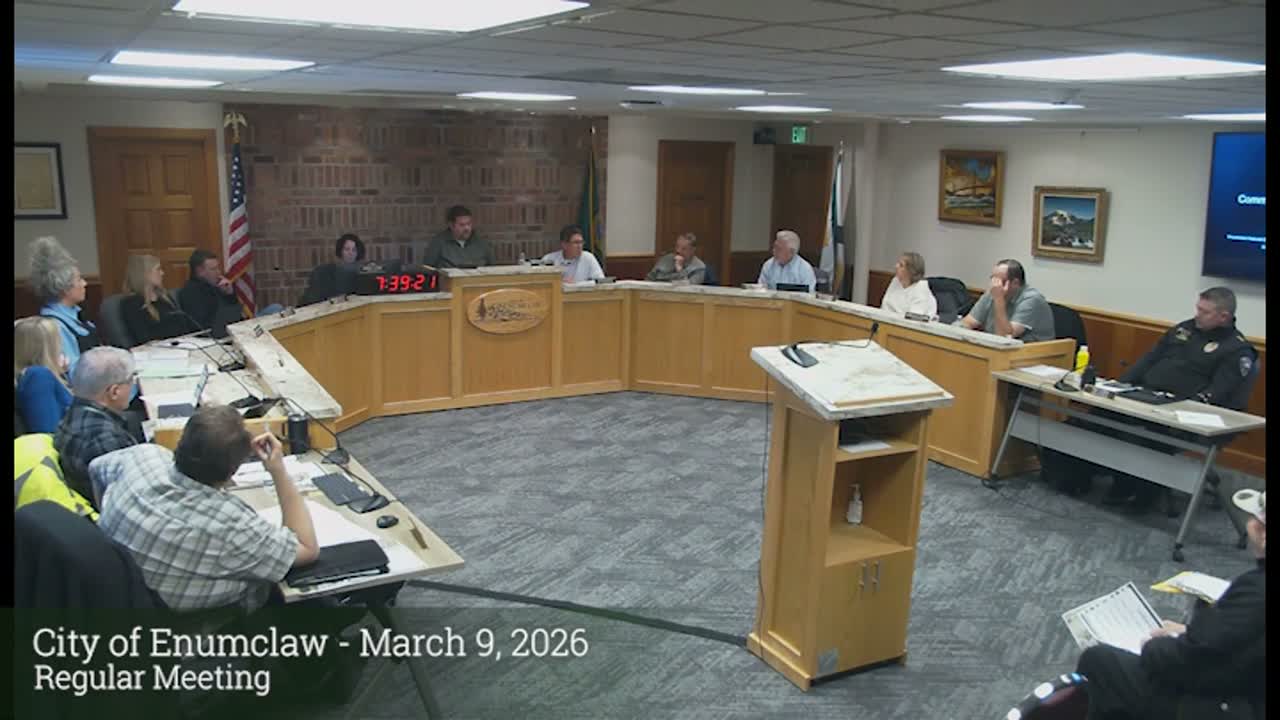
City Administrator Chris Searcy briefs Enumclaw council on Climate Commitment Act and rising compliance costs
Summary
City Administrator Chris Searcy told the Enumclaw City Council that the Climate Commitment Act (CCA) already covers the city's municipal gas utility and that recent emissions put the utility just above the 25,000 metric-ton threshold; staff warned compliance costs could grow and asked the council for policy guidance and time to explore alternatives and funding options.
City Administrator Chris Searcy told the Enumclaw City Council on March 9 that the state's Climate Commitment Act (CCA) already applies to the city's municipal gas utility and could drive rising compliance costs unless the city takes mitigation steps.
Searcy, who led a workshop-style briefing, said the city's average emissions from 2023 through 2025 were "a little over 25,000 metric tons," narrowly placing the utility above the statutory 25,000-ton threshold that defines a "covered entity." He said Ecology provides some "no-cost allowances" initially but those allowances decline over time and the city will need to buy additional allowances at auction as the program progresses.
Why it matters: Searcy said the local gas utility's compliance costs are already measurable (he estimated about $250,000 in 2023 and roughly $400,000 in later years) and that those costs could grow to more than $1 million annually depending on carbon prices and market linkage. Those costs affect the utility's operating budget and customer bills; staff has placed a CCA compliance charge on customer bills and differentiates between "legacy" customers (eligible for auction-proceeds offsets) and "non-legacy" customers (new connections after July 25, 2021, who are not eligible for offsets).
What the city described: Searcy explained the program mechanics: Ecology runs quarterly auctions for carbon allowances; the city receives some no-cost allowances (based on a historical baseline), but the share of allowances the city must consign to auctions increases over time and the no-cost portion is reduced annually. He said the city could exit future compliance periods if it keeps emissions below 25,000 metric tons for each year of a four-year compliance period, but Ecology can retain entities near the threshold (within 10 percent) under its rulemaking discretion. Searcy noted that weather-driven demand for space and water heating is the chief driver of year-to-year emissions changes.
Options and next steps: Searcy outlined options staff would like council guidance on, including exploring full cost recovery for new development, pursuing alternative compliance arrangements with other municipal gas utilities (Ellensburg was cited as a partner exploring a restricted-account approach), seeking state or grant funding for decarbonization planning, and adding staff or technical resources to run a customer-conversion program (for example, heat-pump conversions). He said staff would return to the council in May with additional information and projections and asked council members to solicit input from peers and legislative representatives in the meantime.
Direct quotes and clarifications: "We are just marginally over the threshold," Searcy said of the city's emissions, adding that the city's compliance baseline and the way Ecology calculated the baseline were the subject of a prior appeal. He said the city's first-year CCA cost was about $250,000 and that recent years were closer to $400,000; "we could project out year by year" to show a range based on carbon-price assumptions, he said, but emphasized that linkage to other markets (such as California) and the state's greenhouse-gas reporting add uncertainty.
Council reaction and procedural note: Council members asked for more detailed dollar projections and for staff to coordinate with other municipal utilities and the city's state legislative delegation. Searcy said staff has been managing CCA reporting and participation so far but would need additional personnel and technical support to implement a customer-conversion or targeted decarbonization program.
What happens next: Staff will return with more detailed cost projections, potential policy options (including full cost recovery and alternative compliance pathways), and requests for resources or consultant support. Searcy invited the council to revisit the topic in May.