Get Full Government Meeting Transcripts, Videos, & Alerts Forever!
Get email alerts on the Microtransit Plan topic
No spam. Unsubscribe anytime.
Study recommends phased microtransit pilot in East Grand Forks; year‑one operating costs estimated at $360,000–$530,000
Summary
Consultants presented a microtransit feasibility and implementation plan recommending a phased pilot focused on East Grand Forks, starting with one vehicle and expanding to two–three vehicles; the plan outlines operational models, technology options, KPIs and potential MnDOT/MPO funding, while city transit staff said service likely would not start until 2027.
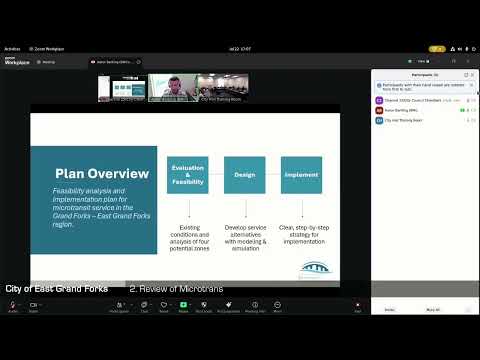
Consultants presented a microtransit feasibility, design and implementation plan for the Grand Forks–East Grand Forks region and recommended a phased pilot that focuses initially on East Grand Forks.
"Microtransit is an app‑based, on‑demand service similar to Uber or Lyft that can be open to anyone," said Aaron Bartling, senior transit planner and project manager, describing the study’s analysis, preferred service zone and operational recommendations. The study recommended starting with a limited pilot (one vehicle for evening service), then expanding to all‑day service and a fleet of two to three vehicles in the full‑service phase.
The plan compared four candidate zones and found the East Grand Forks zone to be the top performer in the analysis. Bartling presented forecast ranges for ridership and a budget estimate for the first two years: "Year 1 a bit lower... ranging in that $360 to $530,000 range for operations annually," he said. The consultant recommended a direct‑operations model to retain local operators and institutional knowledge, and noted technology platforms such as Ecolane as possible software providers.
City Area Transit staff cautioned that implementation requires coordination with MnDOT and lead times for vehicle procurement and operator staffing. One staff representative said, "Since we've already applied for 2026 operating application through MnDOT, we would not start operating ... at least until 2027." The plan identified MnDOT and MPO grant opportunities to help underwrite operating and capital needs and proposed KPIs — ridership, cost per passenger trip, wait times and customer satisfaction — to measure performance over a one‑year data collection period before major changes.
Council members asked about how microtransit would interact with existing fixed routes. Consultants said the model would complement strong fixed routes and could replace underperforming routes, with riders picked up at stops within roughly a quarter‑mile service area rather than true door‑to‑door dial‑a‑ride service.
Next steps: the consultant said the plan will go to MPO committees for approval next month and staff will pursue funding conversations with MnDOT and other partners. Staff emphasized further discussion of procurement choices, service area boundaries and operational details before any launch.