Get Full Government Meeting Transcripts, Videos, & Alerts Forever!
Get email alerts on the Land Use Rezoning topic
No spam. Unsubscribe anytime.
Neighbors oppose Lockhart townhome project; applicant withdraws future-land-use amendment after heated public opposition
Summary
Hundreds of neighbors mobilized against a proposal to convert a 6.8-acre Lockhart parcel into 46 fee-simple townhomes, citing traffic, compatibility with the historic neighborhood, wetlands and infrastructure concerns. The applicant withdrew the future-land-use and rezoning request during the meeting.
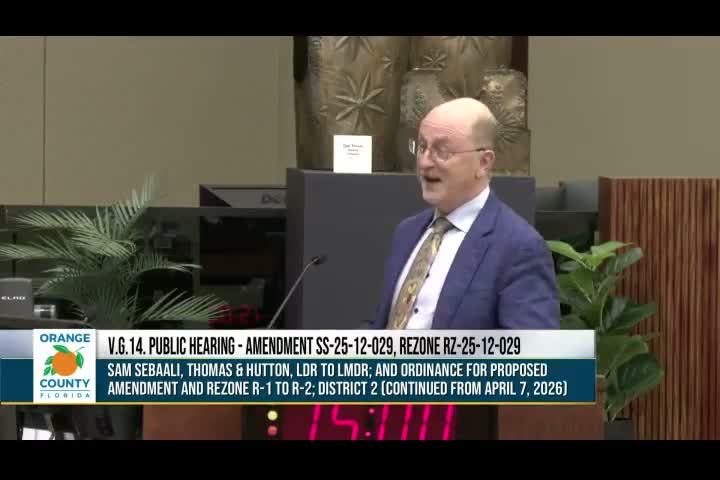
A proposed rezoning and future-land-use change to allow 46 fee-simple townhomes on a 6.28-acre parcel in the Lockhart neighborhood drew strong opposition April 21, and the applicant subsequently withdrew the application.
What was proposed: The applicant sought a future-land-use amendment from low-density residential to low-medium-density residential and a zoning change (R1 to R2-restricted) to permit 46 townhome units. The proposal followed an earlier entitlement allowing about 23 single-family lots for the same site; developers said infrastructure costs for single-family lots were prohibitive and proposed townhomes as a financially feasible alternative.
Neighbors' objections: Dozens of nearby homeowners packed the meeting to oppose the plan, saying the development is incompatible with the corridor's long-standing single-family character, would create cut-through traffic on small two-lane roads, and risked increased stormwater and wetlands impacts in the Little Wekiva area. Multiple speakers said the area's lots are typically several times larger than the proposed townhome parcels and argued that the density and scale proposed would alter the historic character. Neighbors collected petitions and dozens of residents testified in person.
Planning review and applicant response: Planning staff and the county's technical reviewers examined the submittal and the project's traffic and stormwater analyses; the planning-and-zoning/local-planning-agency hearing had public opposition and recommended denial. The applicant and project counsel argued that the single-family plan was not financially feasible without a new public sewer lift station and that townhomes could be offered as fee-simple, owner-occupied housing at mid-market prices (applicant-estimated pricing in the $380,000$450,000 range). The applicant offered concessions in response to neighborhood concerns, including enhanced buffers, preserved tree stands on the northeast corner, additional on-street guest parking and an HOA restriction limiting rentals; however those concessions did not produce neighborhood consensus.
Outcome: During the meeting the applicant's attorney said the development team would withdraw the future-land-use amendment and rezoning request rather than continue amid the strong neighborhood opposition. The withdrawal means the pending zone-change and plan amendment will not move forward at this time.
Why it mattered: Neighbors argued the site sits within a long-established low-density corridor with century-old homes and that a sudden jump in density would degrade tree canopy, strain local roads and alter neighborhood character. The applicant cited rising infrastructure costs, especially sewer lift-station requirements, and argued that townhomes would provide fee-simple housing at price points unattainable with single-family lots under current utility constraints.
What's next: Because the application was withdrawn at the meeting, no vote was taken. The developer indicated willingness to re-engage; residents asked for clearer notice and more community meetings if another submittal is contemplated. County staff said any future submittal would be considered in accordance with zoning rules, the future land-use map, and the county's Wekiva-area protections.
Speakers quoted (selected): "This is an established, clearly defined neighborhood," said Debbie Salamone, summarizing a frequently cited argument: that the corridor contains older, larger lots and a historic character. "The area is a stable historic neighborhood," Tamara McClung added. On behalf of the applicant, counsel argued that "infrastructure costs make the 23 single-family-lot plan infeasible; the townhome approach funds necessary sewer infrastructure."