Get Full Government Meeting Transcripts, Videos, & Alerts Forever!
Get email alerts on the Strategic Planning topic
No spam. Unsubscribe anytime.
EDA reviews draft strategic goals, debates role in housing and schedules EDA-district public hearing
Summary
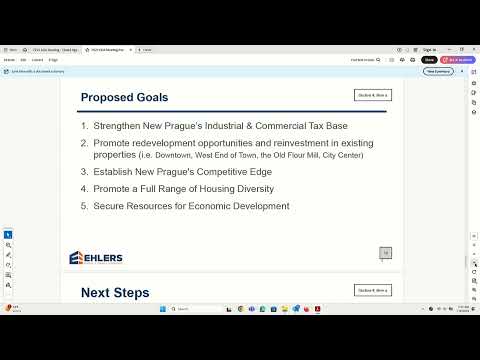
The New Prague EDA reviewed a five-goal strategic plan that emphasizes industry recruitment, downtown reinvestment, branding, housing diversity and funding, debated whether the EDA should take an active role in housing, and asked staff to queue a public hearing in August to form an economic development district.
The New Prague Economic Development Authority reviewed a draft five-goal strategic plan on topics ranging from industrial recruitment and downtown reinvestment to branding, housing diversity and funding strategies, and discussed whether the EDA should take a more active role in housing development.
A consultant presenting the plan said the EDA could shift from buying land to partnering with private developers, facilitating streets and utility extensions and using tools such as a tax‑increment financing district to reimburse developers over time. “We don’t necessarily think over the next 5 to 10 years you necessarily have to go out and buy land,” the presenter said, arguing the EDA can be an active development partner without large upfront land purchases.
Members pressed on wording and measurement. One committee member asked whether the goal should emphasize growth as well as strengthening; the presenter said strategies and action items would make goals more measurable. Another member cited supply constraints, noting, “We have less than 10, I think, available” lots left in the industrial park, a point used to connect housing availability and business recruitment.
Housing was the most contested point. The presenter proposed promoting a full range of housing types—single‑family lots, townhomes, duplexes and garden‑style apartments—to help the local workforce find housing. Several members said they support evaluating housing but were unsure whether it belongs in the EDA’s core remit. “Are we really on board with that idea of actually being actively involved?” one committee member asked, urging clearer scope and resource commitments before adopting housing as an EDA priority.
Staff also recommended considering whether to formalize an economic development district to give the EDA additional authority for some financing and ownership tools. The director offered to queue a public hearing for the August meeting to begin that process if the EDA had no objections.
The presenter said next steps include refining the goals based on EDA feedback, holding a joint EDA–city council meeting, drafting strategies and action items, and returning with a completed plan for review—an estimated one‑to‑two month process. No formal policy or funding decision on housing was made at the meeting; members asked staff to return with evaluations and clearer options.
The meeting closed with business and partner updates from city staff and the CDA.