Get Full Government Meeting Transcripts, Videos, & Alerts Forever!
Get email alerts on the Housing topic
No spam. Unsubscribe anytime.
Residents press Bozeman commissioners on housing, 'Ward' initiative and homelessness
Summary
Public comment emphasized housing affordability, the local 'Ward' water/affordability initiative, homelessness and neighborhood safety. Speakers urged a mix of policy responses including a voter-backed linkage program, a housing study and alternatives to camping bans.
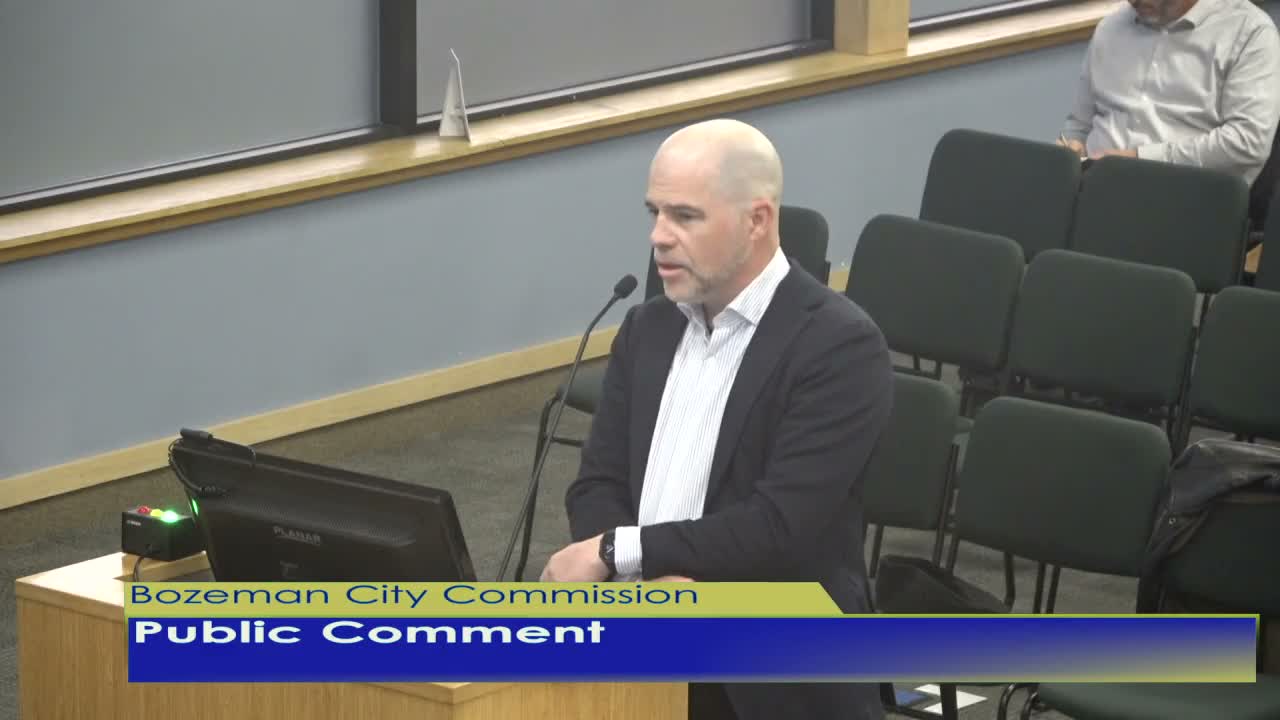
A broad array of residents and students used the public-comment period at the Oct. 28 Bozeman City Commission meeting to press officials on housing, the Ward water-adequacy initiative, homelessness policy and local street safety.
Daniel Carty of the Ward Working Group described the initiative’s core mechanism and urged a yes vote: "Ward seeks to allow new residential developments of 3 or more dwelling units to pay the city cash in lieu of water rights only if such developments include 33% or more of affordable dwelling units for rent or for sale," he said, adding the measure defines affordable rentals as 60% of area median income and sales as 120% AMI with deed restrictions as allowed by Montana law.
Student speakers and neighborhood residents raised complementary housing proposals. Jack Shepherd recommended a voter measure to levy taxes on secondary homes and short-term rentals to finance affordable housing, including specific rent and sale caps; Olivia Belcher asked the commission to staff a one-year housing study to assess who current housing serves and what types of housing are needed.
On homelessness, Jake Moore (resident and MSU student) said the temporary ordinance that permitted managed urban camping (Ordinance 2172) has expired and urged the commission to consider extensions or alternatives such as city-managed campgrounds and expanded shelter partnerships. "Homelessness isn't solved by visibility bans. It's solved by opportunity, stability, and compassion," Moore said.
Other comments touched on conservation (a student asked for a resolution to preserve roadless protections), pedestrian safety (a request for sidewalks on Willow Way) and neighborhood-preservation concerns raised later during the NCOD design-guideline discussion.
Takeaway: public comment showed overlapping themes: voters and residents are seeking concrete tools to address housing affordability (tax measures, linkage policies like Ward, and targeted studies), humane options for people experiencing homelessness, and stronger outreach and transparency from city staff on planning matters.