Get Full Government Meeting Transcripts, Videos, & Alerts Forever!
Get email alerts on the Housing Ward Initiative topic
No spam. Unsubscribe anytime.
Analysts and pollsters say Bozeman ‘Ward’ mandate would need subsidies to meet affordability goals, warn of sprawl risk
Summary
Regional housing coalition analysts and a new poll presented to the Bozeman City Commission said the Ward water adequacy ballot initiative could make many housing projects financially infeasible without subsidy and could shift development outside city limits; the poll found widespread concern about housing but a plurality undecided on Ward.
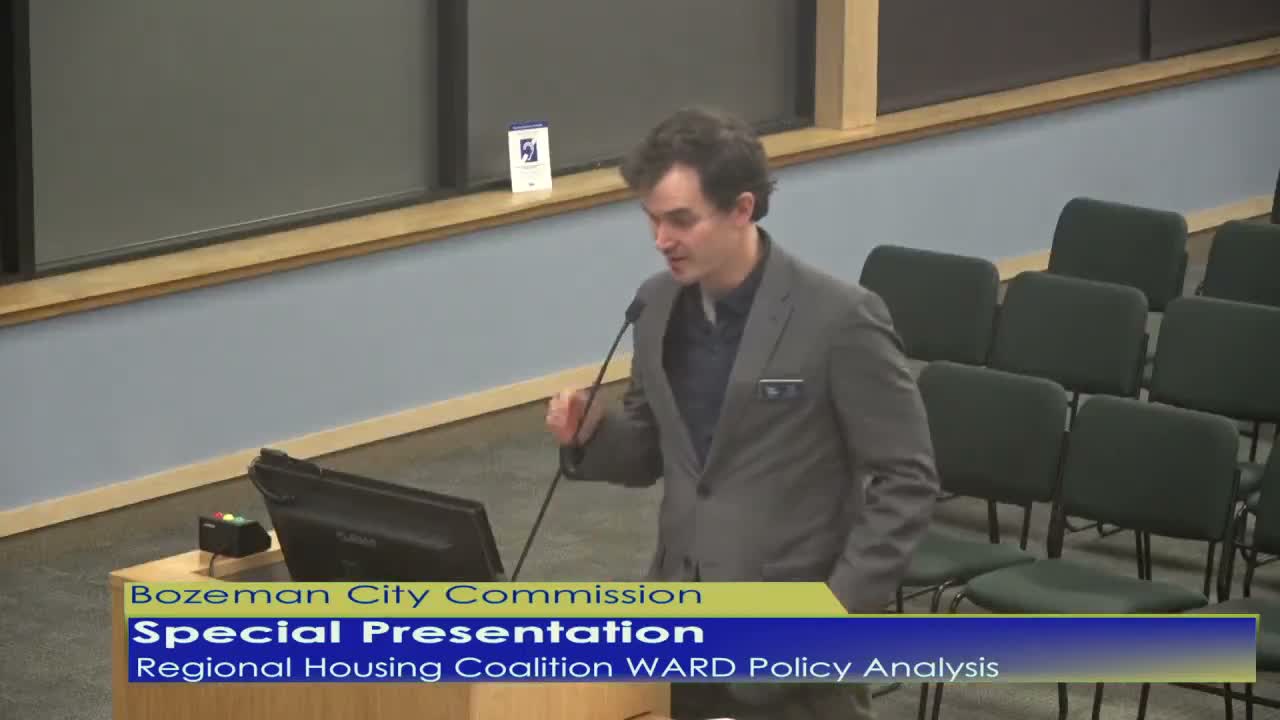
Mark Bond, community engagement manager for One Valley and a lead on the Regional Housing Coalition’s Ward work group, told the Bozeman City Commission on Oct. 7 that a capital gap — the difference between the cost to build housing and what is affordable to target households — is the fundamental barrier to producing more below-market housing in the Bozeman area.
Bond said the coalition’s policy analysis found that Ward, which would require developers of projects with three or more units who pay cash-in-lieu of water rights to provide 33% of those units at about 60% of area median income, would impose a significant cost burden on mixed-income developments unless paired with subsidies or other incentives. “Mandating a high level of affordability without providing a corresponding subsidy … would make most market-rate development financially unfeasible,” Bond said.
The Regional Housing Coalition’s analysis cited local nonprofit developers’ experience showing large per-unit capital gaps — the presentation used a Bridger View example with a roughly $700,000 per-unit build cost and an estimated $350,000 gap for lower-priced units — and recommended grant or land donations, tax credits, or other direct subsidies to bridge the gap. Bond said the likely outcome if Ward made development inside Bozeman harder would be more county development, increased sprawl, and greater reliance on septic systems and noncentral water infrastructure.
Nathan Stein, executive director of Headwaters Community Housing Trust, and Betsy Apt of polling firm Embold Research presented a new survey of roughly 424 registered Bozeman voters conducted in early September. The poll found 69% of respondents said Bozeman does not have enough housing options to meet residents’ needs, and 78% said they or someone they know had been impacted by housing shortages. On Ward specifically the sample split: 29% said they supported the initiative, 35% opposed it and 36% were undecided.
Stein said the trust ran the poll to test public appetite for local solutions and to better understand demand for below-market homeownership and rental housing. Apt described the methodology and said the sample was weighted by age, gender, race/ethnicity, education, two Bozeman ZIP codes and 2024 presidential vote; the firm reported a margin of error of roughly 5.5 percentage points.
Public commenters at the meeting took opposing positions. Daniel Carty, a Ward co-author, argued two technical reports supported the initiative’s ability to create mixed-income development and help workers remain in the city. Several residents and local organizations represented in the staff FYI — including EPS, HRDC and Headwaters Community Land Trust — were cited in the city’s summary as concluding Ward’s targets would likely be infeasible without significant subsidy.
The commission did not take a vote on Ward at the meeting; staff said the commission will hold a more focused discussion on Oct. 21 to examine land-use implications of the initiative. The presentations and the poll were posted to the meeting record for residents to review.
Ending
Commissioners and staff framed the presentations as part of an ongoing community conversation about housing supply and the role of local policy. No formal action on Ward was taken at the Oct. 7 meeting; the commission scheduled further discussion for Oct. 21.