Get Full Government Meeting Transcripts, Videos, & Alerts Forever!
Get email alerts on the Land Use Sundance Springs topic
No spam. Unsubscribe anytime.
Bozeman commission upholds director’s conditional approval for Sundance Springs commercial lot, adds lighting condition
Summary
The City Commission denied a neighbors’ appeal of a commercial-site plan for Sundance Springs Lot 2, adopting an added lighting condition but rejecting a proposal to remove parking from the rear setback. The main motion passed 4–1 after extended legal and planning debate.
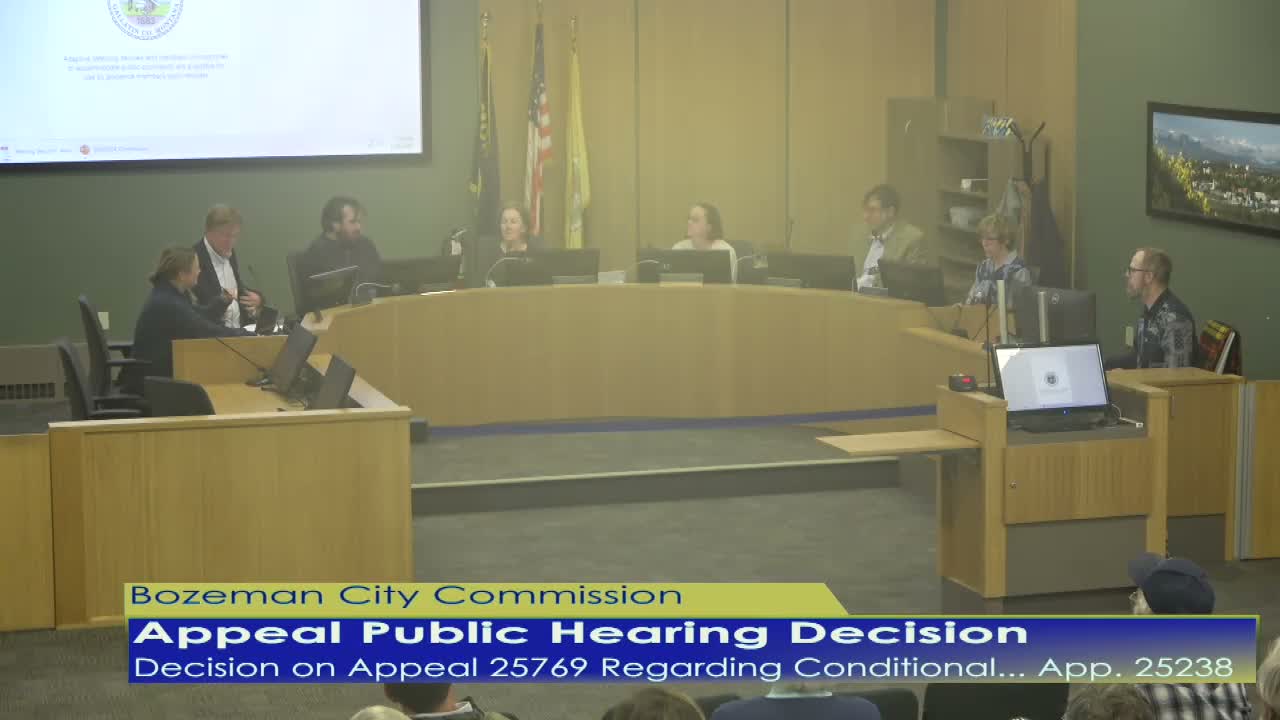
The Bozeman City Commission on March 24 denied an appeal of the director of community development’s conditional approval for the Sundance Springs Commercial Lot 2 site plan, voting 4–1 to uphold the decision while adding a condition limiting exterior lighting.
Commissioner Magick moved to amend the director’s conditional approval to require an updated lighting plan that complies with a maximum of 0.3 foot‑candles at the property boundary and to approve the amended conditional approval. Commissioner Sweeney seconded for purposes of discussion. After deliberations focused on whether PUD master‑plan materials are binding and whether code or covenants control specific design elements, the amended approval passed 4–1. “I move to approve the amended conditional approval of the Sundance Springs Commercial Lot 2 site plan application,” Commissioner Magick said before the vote.
Commissioner Sweeney argued the site plan still failed to meet block‑frontage standards and proposed a separate amendment to eliminate parking in the rear setback and allow only landscaping there, citing the Sundance Springs covenants and prior 2024 commission findings. “It needs to be eliminated and only landscape improvements may be allowed,” Sweeney said. That amendment was put to roll‑call and failed 1–4: Commissioner Sweeney voted aye; Deputy Mayor Fischer, Commissioner Bode and Commissioner Magick and Mayor Joey Morrison voted no.
Discussion at the dais centered on three technical questions repeated across speakers: whether master plans and development guidelines are regulatory, which municipal code applies to an application (the commission applied the 2025 code in effect when the application gained adequacy), and whether the final plan and covenants impose additional limits. Commissioner Magick and other supporters of the director’s decision argued that master‑plan maps are conceptual marketing materials and that covenants — not the master plan — would be the instrument to add legally binding restrictions. “These are nonbinding, nonregulatory documents,” Commissioner Magick said when describing the role of the master plan and development guidelines.
Opponents pointed to the commission’s 2024 findings and argued certain design guidelines and covenant language (cited during the hearing as Section 8.3.c of the CCRs) should preclude parking in the setback and require different frontage treatment for buildings. Commissioner Sweeney said the West Building’s entrance faces the parking lot rather than Little Horse Drive and that the plan therefore did not satisfy the order of precedence for frontage in the code.
Assistant City Attorney Savage reminded the commission the hearing record was closed at an earlier session and that their task tonight was to make findings and a decision based only on that record. The vote to uphold the director’s conditional approval — with the added lighting condition — was recorded by the deputy clerk and adopted 4–1. The commission incorporated staff findings into the record and moved on to other city business.
Next steps: the amended conditional approval becomes the commission’s formal action on the appeal; the record of the case remains the basis for any judicial review. The commission did not direct further amendments or remands on this item during the meeting.