Get Full Government Meeting Transcripts, Videos, & Alerts Forever!
Get email alerts on the Housing Affordability topic
No spam. Unsubscribe anytime.
Bozeman public commenters press commission on housing: support for Ward ballot initiative and calls for more affordable, student‑friendly housing
Summary
Multiple public commenters urged the commission to address housing affordability and supported the Bozeman Water Adequacy (WARD) ballot initiative requiring higher affordable‑unit thresholds; residents and students described cost burdens, urban camping, and urged the city to consider stronger incentives and oversight.
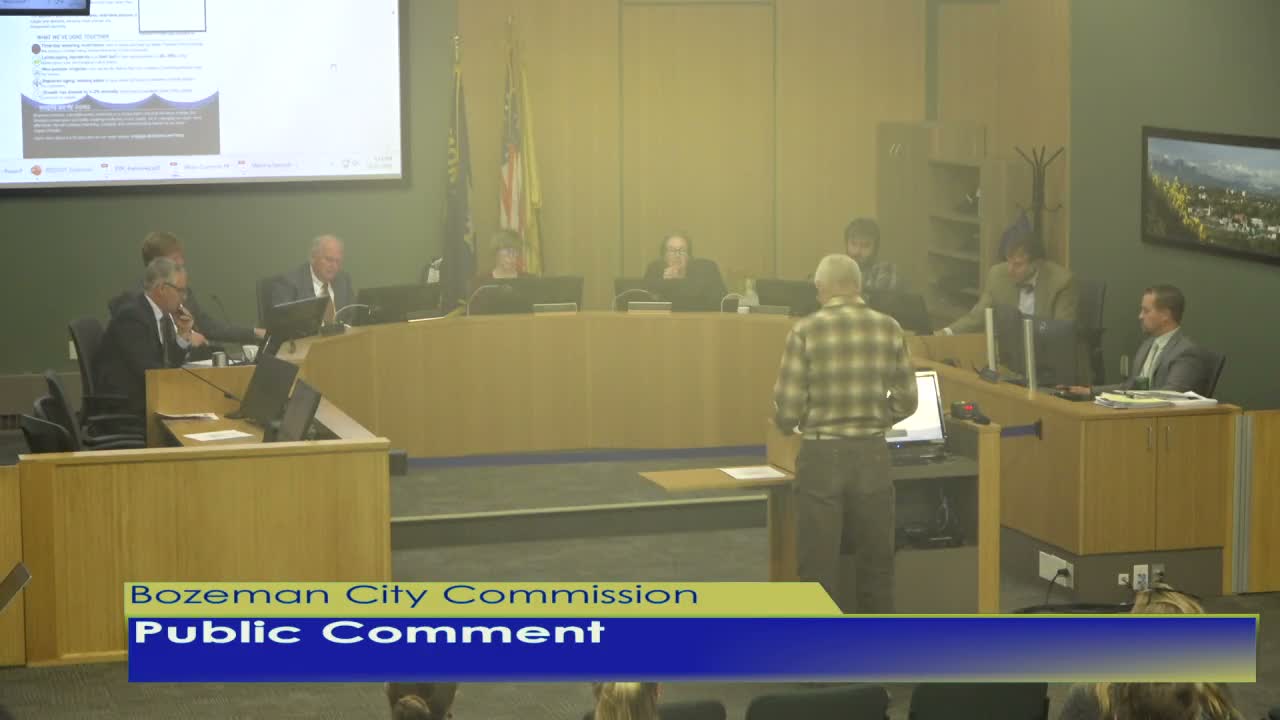
During the general‑public‑comment period the commission heard repeated concerns about housing affordability and support for a ballot initiative known locally as WARD (Bozeman Water Adequacy for Residential Development).
Daniel Carty, a co‑author of the Ward initiative, urged voters to support a measure that would require 33 percent affordable units for new residential developments of three units or more that use the city’s cash‑in‑lieu water‑rights program; Carty contrasted that requirement with a city study that staff said suggested developers could only provide 5 percent affordable units without subsidies.
Students and working residents spoke about high rents and housing instability. Macy Cotton and several MSU students said the current market forces students and essential workers into cost‑burdened situations, with one student noting a typical one‑bedroom rent near $1,800 and a median home price above $800,000.
Other commenters, including a mayoral candidate, urged the city to consider creating a public housing authority and pursuing revenue bonds to build city‑owned affordable housing. Commissioners did not take formal action on the comments but heard the recurring themes of student affordability, middle‑class cost burden, and concern that the city’s current approach will not meet projected affordability needs.