Get Full Government Meeting Transcripts, Videos, & Alerts Forever!
Get email alerts on the Land Use Udc topic
No spam. Unsubscribe anytime.
Bozeman commission adopts new Unified Development Code after heated debate over downtown height limit
Summary
After hours of public testimony and commissioner questions, the Bozeman City Commission adopted ordinance 2,151—the city’s rewritten Unified Development Code—and approved restoring a 90-foot building height limit in the B3 downtown fringe by amendment. Commissioners said the code is intended to be iterated after implementation.
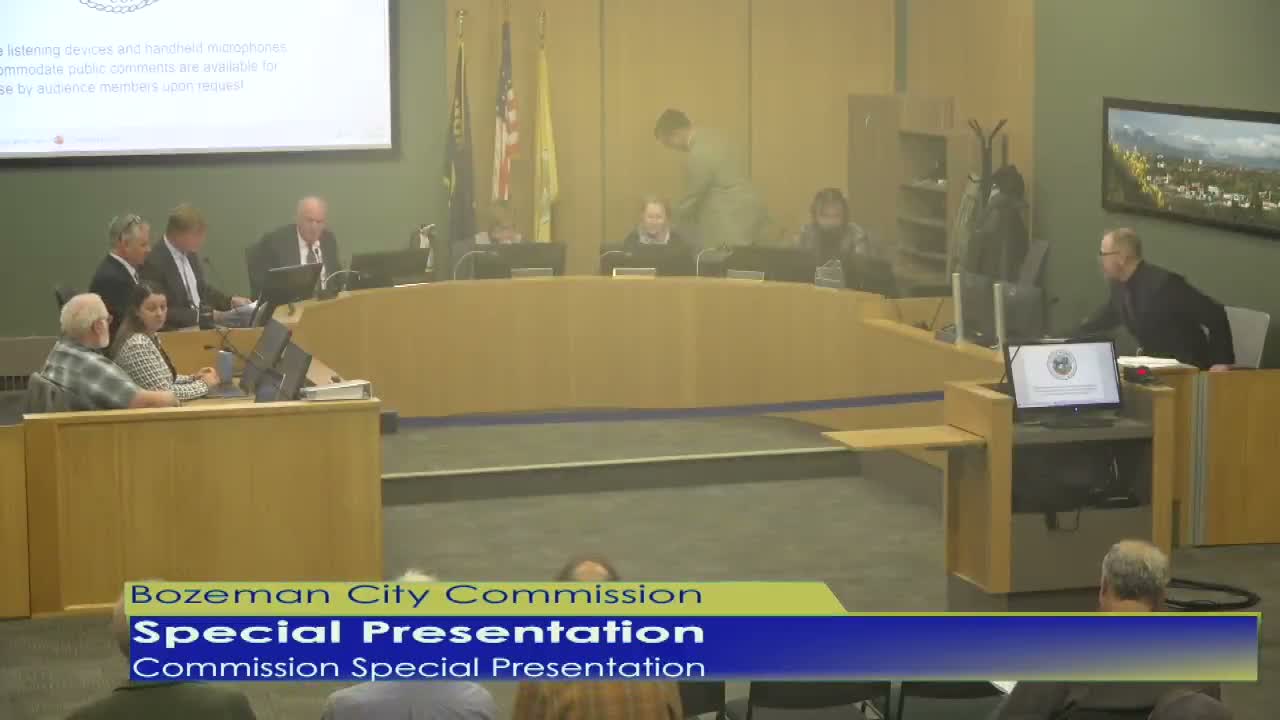
The Bozeman City Commission on Dec. 16 adopted ordinance 2,151, the city’s consolidated Unified Development Code (UDC), after several hours of staff presentation, public testimony and commissioner debate over height limits in the downtown B3 zoning district.
The ordinance, described by staff as the final repeal and replacement of chapter 38 to comply with the Montana Land Use Planning Act and to implement the Bozeman Community Plan, passed after an amendment to restore the B3 height back to 90 feet won 4–1; the main motion to adopt the complete UDC then passed unanimously.
City planner Chris Saunders told the commission the UDC is the product of a multi-year process that created the new B3C (core) and revised standards for height, transitions, affordable housing incentives and natural-resources review. Saunders said state law also affected draft language, including a minimum 60-foot allowance in downtown core areas adopted in recent state legislation.
Commission questions focused heavily on the B3/B3C standards, transition measures where commercial edges meet residential zones, and whether the code provides sufficient design standards and landscaping to mitigate taller buildings. Saunders explained the code uses a mix of articulation, stepback and transition setback tables and that staff expects to refine ministerial errors and nonmaterial cross-references during codification.
Public testimony spanned more than an hour and split the room. Supporters of a 90-foot B3 limit argued taller buildings in the fringe of downtown will enable density, tax revenue and the potential to leverage affordable housing incentives. "This will create walkability and density and help the downtown remain the heart of our community," said Marlee McKenna, who urged the commission to "stay the course" with the 90-foot draft.
Opponents urged maintaining the commission’s earlier adjustment to 70 feet (or even a lower 60 feet in the fringe) to protect downtown character, prevent shadows and avoid giving away height without guaranteed public benefit. "When you give something away for free, it will be almost impossible to get it back," said Lisonbee Sweeney, chair of the Jant Neighborhood, urging the commission to keep the height limited and leverage height for affordable housing rather than granting it by right.
Commissioner Fisher, who brought the motion to return the B3 text to 90 feet as reflected in the Dec. 2 draft, said the 90-foot allowance had been part of a multi-year public process and that reversing it two weeks earlier had been a consequential last-minute change. "We're on the cusp of approving a 500-page massive overhaul of how we grow," Fisher said; "I think the fairest way to proceed is to return to the UDC text to what it was and what the public had vetted."
Deputy Mayor Morrison and other commissioners emphasized that the UDC is an iterative, "living" document that staff and the commission can refine, and that various design standards in Article 5 strengthen articulation and massing requirements. Saunders noted the UDC includes provisions to require stepbacks and landscaping where districts abut and to use the city’s affordable housing ordinance to incentivize additional height tied to housing outcomes.
The commission approved the amendment to restore 90 feet in the B3 district 4–1, with Commissioner Majic recorded as the lone No vote. After handling a small set of ministerial cleanup directives and confirming the effective date language, the commission adopted ordinance 2,151 for final adoption by unanimous vote.
The commission and staff said the next steps will include community education, implementation details, and possible future refinements—particularly on transition standards and potential site-specific design criteria should the commission decide to require additional public benefits for greater height.