Get Full Government Meeting Transcripts, Videos, & Alerts Forever!
Get email alerts on the Public Safety topic
No spam. Unsubscribe anytime.
Bozeman police outline scope and strains of Special Victims Unit in public presentation
Summary
Detective Captain Anthony Hutchings told the City Commission the Special Victims Unit handles the majority of domestic and sexual violence cases requiring specialized investigation, described staffing and interagency partnerships, and promoted community outreach including an assault‑awareness event April 15.
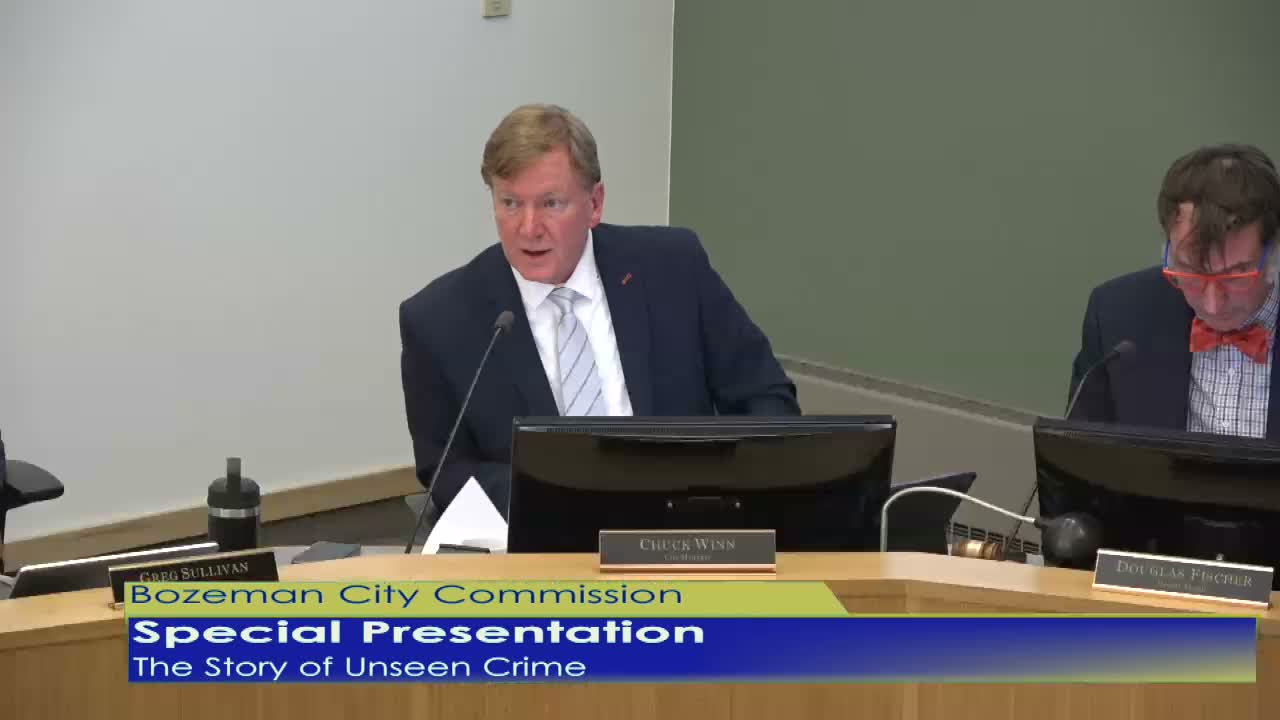
Detective Captain Anthony Hutchings of the Bozeman Police Department briefed the City Commission on the department’s Special Victims Unit (SVU), describing the unit’s staffing, caseload and partnerships and urging increased community awareness and reporting.
Hutchings said the SVU — formed in 2017 with personnel from Bozeman Police and Montana State University Police, plus an Internet Crimes Against Children investigator — focuses on domestic and sexual violence, child physical and sexual abuse, stalking, strangulation and crimes involving digital exploitation. "Out of all those cases, roughly 65 percent of them go straight to our SVU," he said, and "roughly 45 percent of them involve children," underscoring the unit’s concentration on vulnerable victims.
Hutchings described the SVU’s digital forensics and investigative resources and credited collaborations with health providers, school resource officers and local child‑advocacy organizations for referrals and victim support. He said many serious offenses do not reach the system: national estimates show significant underreporting, and Hutchings told the commission that local reporting rates likely mirror those national trends.
He also flagged strangulation as a statutory and investigatory focal point, citing national research on its association with higher rates of attempted and completed homicide. Hutchings closed by noting the department’s community outreach plans, including an assault‑awareness night on April 15 at the Safety Center to educate residents about signs of abuse and reporting options.
Mayor and commissioners thanked Hutchings for the "sobering presentation," and staff and commissioners said they value the department’s victim‑centered work and interagency cooperation. Hutchings said the SVU’s goals include improved digital evidence handling, enhanced training and greater community education to raise reporting and reduce unseen harm.
The presentation was informational; no formal action was taken. The department asked the public to note the April 15 awareness event for survivors and community members interested in learning more.