Get Full Government Meeting Transcripts, Videos, & Alerts Forever!
Get email alerts on the Capital Plan topic
No spam. Unsubscribe anytime.
Bozeman staff outline $289 million five‑year CIP; water projects, public‑safety tech and housing funding highlighted
Summary
Staff presented a draft five‑year Capital Improvement Plan (~$289M) that prioritizes public works and utilities spending, proposes a $1.9M public‑safety technology subscription, sets aside $1.5M for ERP replacement and adds $2.1M for community housing design; commissioners asked about timing, sustainability and project tradeoffs.
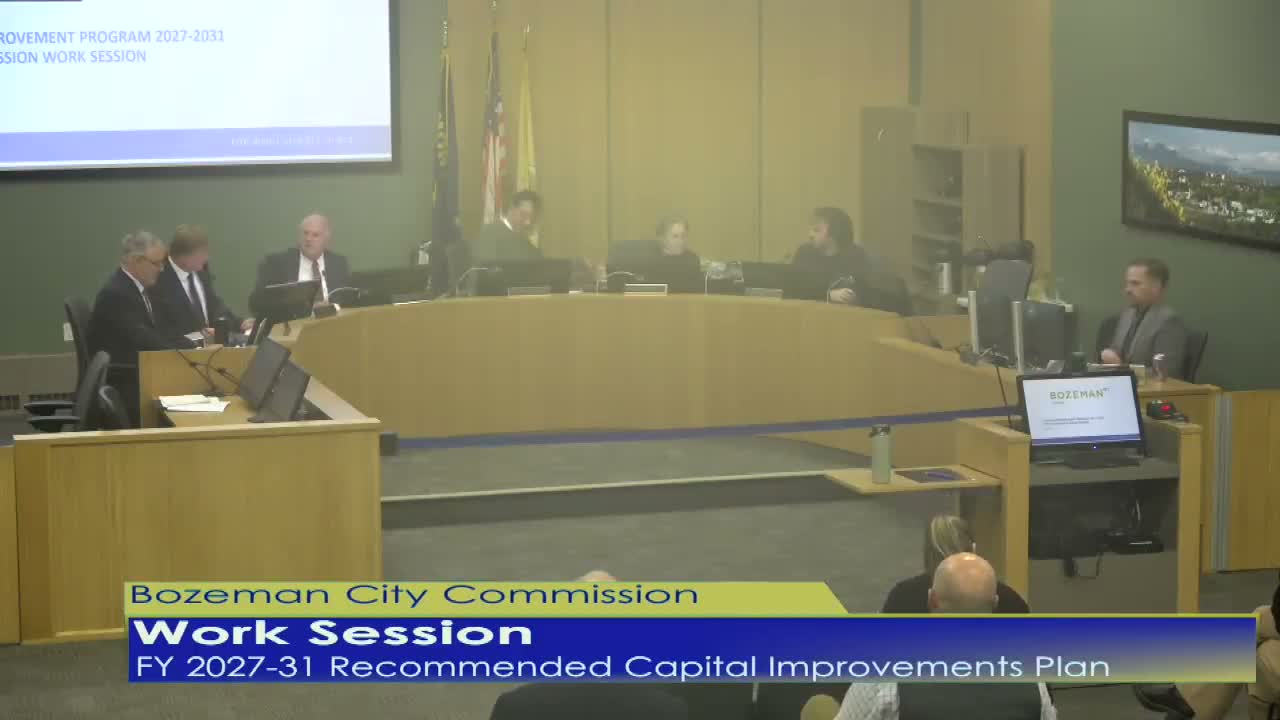
City staff presented a draft five‑year Capital Improvement Plan totaling about $289 million and walked the commission through major programmatic priorities, funding sources and several projects likely to require further policy decisions.
Finance Director Melissa (presenting with staff) said the plan focuses on protecting existing assets, addressing deferred maintenance and planning for growth. Public works and utilities account for the large majority of the proposed spending; staff described a multi‑year program of water and sewer main replacements, tank and intake rehabilitations, a Highlight Reservoir optimization study and investments in stormwater treatment to protect Bozeman Creek.
Key items highlighted in discussion:
- Water & wastewater: Utilities Director Sean Coats outlined ongoing condition assessments (Lyman and Sourdough tanks, long transmission mains) and a phased approach to capacity increases at the Water Reclamation Facility, noting planning and permitting steps are underway. Coats said some projects (e.g., Highlight intake rehabilitation, Sourdough natural storage/scenario work) are engineering investigations to avoid overbuilding expensive infrastructure prematurely.
- Community housing / Fowler: The CIP includes $2.1 million in FY27 for design and engineering to support potential long‑term affordable for‑sale homes on the Fowler property; staff said the model would have the city absorb development overhead to lower end prices.
- Public safety technology: The plan adds an estimated $1.9 million for an integrated, subscription‑based package for body‑worn cameras, in‑car video and digital evidence management; staff and the deputy chief acknowledged sticker shock but said vendor reliability and integrated APIs reduce administrative friction. The recurring subscription cost at scale was flagged as a new operating cost to be modeled in the budget process.
- ERP and software: An ERP replacement set‑aside of $1.5 million is in the plan (funded from FY24 savings), with additional allocations for permitting and utility billing software; staff said the project can be paced since current systems are supported, but it will require careful project management.
- Transportation and sidewalks: Director Nick Ross highlighted street maintenance targets (approx. 6–7 lane miles of overlay annually), increased pedestrian/ADA curb‑ramp funding, and a set of STPU and TA grant‑backed projects including Flanders Mill sidewalk and active‑transportation connections. He recommended updating the Transportation Master Plan in 2027.
Commissioners asked about prioritization, the timing of HVAC and senior‑center investments, opportunities to share equipment across jurisdictions, and the tradeoffs between wetland‑based and in‑facility nutrient removal at the wastewater plant. Deputy Chief Joe Swanson detailed current constraints on converting patrol fleet to electric (equipment loads, battery life in cold weather) and said administrative vehicles are the near‑term candidates for electrification.
No final votes were taken; staff encouraged commissioners to use the next months to review project classes and funding assumptions before the March adoption deadline. The commission also noted the earlier annexation and zoning action (113 Maus Lane to M1) and other votes taken earlier in the evening.