Get Full Government Meeting Transcripts, Videos, & Alerts Forever!
Get email alerts on the Streets Pavement topic
No spam. Unsubscribe anytime.
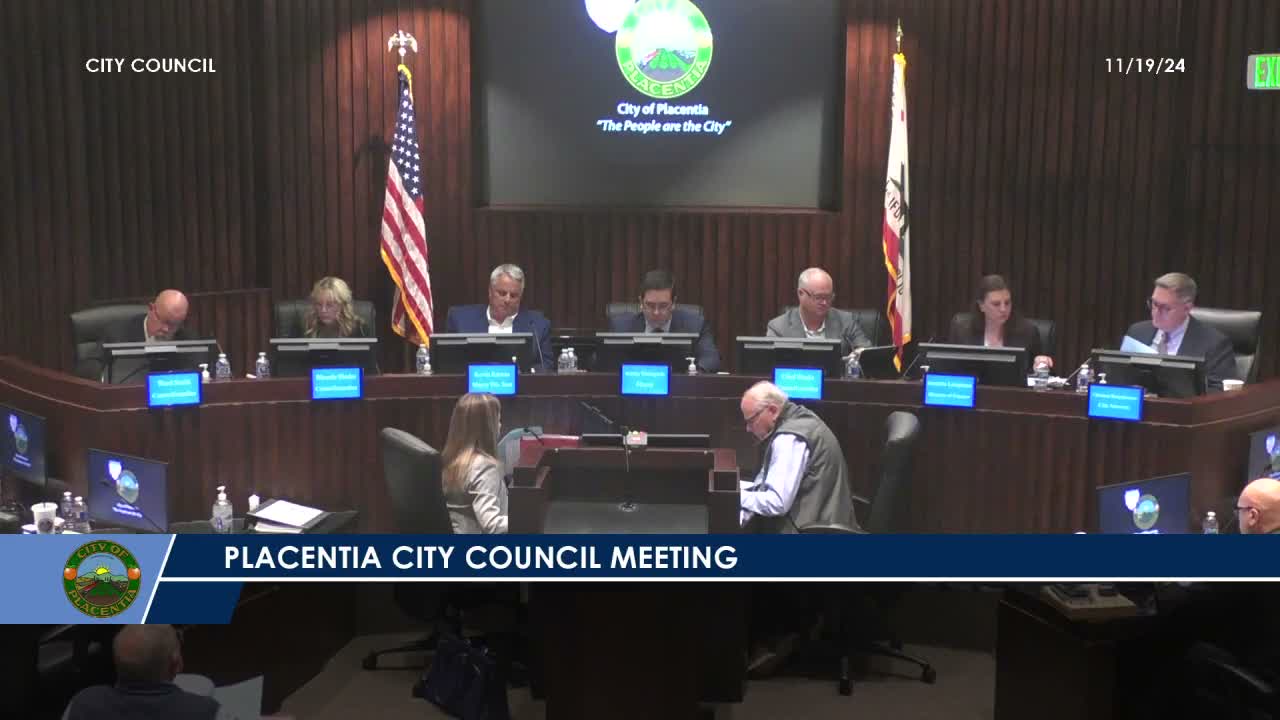
Placentia council approves arterial street rehab, directs staff to pursue full reconstruction for troubled neighborhood
Summary
The Placentia City Council approved a $2.82 million contract for arterial street rehabilitation and instructed staff to return with budget amendments to pursue full-depth reconstruction for a residential neighborhood (Group 4) after hearing resident complaints about long-delayed local streets.
The Placentia City Council on Nov. 19 approved a contract to rehabilitate arterial streets and directed staff to pursue funding and option analyses to complete full-depth reconstruction in one residential neighborhood known as Group 4.
City Public Works staff presented the projects, timelines and costs. Chris Taneo, the director of public works, and Senior Civil Engineer Gabriel Guerrero outlined a two-part plan: an arterial-streets rehabilitation contract (low bid $2,824,600) and a residential slurry-seal project using an ARAM (asphalt rubber aggregate membrane) System 2 pilot in the Group 4 neighborhood. Staff said ARAM System 2 prolongs pavement life roughly 12–15 years, while full-depth reconstruction yields a design life of about 20 years.
Guerrero said the total construction cost across the two projects exceeded available funding. With both projects as-bid, staff reported a combined construction total of about $5.23 million and proposed deferring some Measure U-funded projects to cover the difference. He said the lowest construction bid for the ARAM System 2 work in Group 4 came in at $1,651,276 and that full-depth reconstruction of the same area would add about $700,000 to the cost.
Residents and council members pressed staff for clarity about tradeoffs. Multiple speakers, including residents who said they live near Eldorado High School and Brookhaven, urged prioritizing neighborhood streets and ADA ramps over park or amenity projects. One resident asked why streets in some nearby neighborhoods had been paved while their streets remained in poor condition. Council members likewise questioned whether ARAM was appropriate in parts of Group 4 that residents said were essentially gravel and unsafe; staff replied that localized full-depth reconstruction would be performed where pavement had no remaining service life and ARAM would be applied elsewhere.
After debate, the council first gave staff direction to prepare budget amendments and options to pursue full-depth reconstruction in Group 4, asking staff to identify savings and the mechanics for reallocating funds. That motion passed 5–0. The council separately approved the arterial-streets rehabilitation contract as presented (authorize public works agreement with Sequel Contractors for $2,824,600.40; authorize up to 10% in change orders) by a 5–0 vote.
Mayor Mary Yamaguchi and several council members emphasized staff had been following prior policy direction and that the council could now consider rebalancing Capital Improvement Program priorities. Council members asked staff to return with a budget resolution and timetable; the mayor asked staff to bring options that keep the overall construction schedule moving to the extent possible.
The council also discussed pilot pavement technologies recommended by staff, including a CoolSeal pilot for Cypress Street (unit cost summary presented as roughly $147,672.80 for the pilot area) and ARAM system alternatives. Staff cautioned that rebidding would be required if scope or funding assumptions changed substantially.
Next steps: staff will draft and return with budget amendment language, identify projects for deferral or saving to fund full-depth reconstruction in Group 4, and confirm scheduling and rebid implications if scope is altered.