Get Full Government Meeting Transcripts, Videos, & Alerts Forever!
Get email alerts on the District Finance topic
No spam. Unsubscribe anytime.
Chapel Hill-Carrboro board accepts FY2024 audit; auditors flag Title I over‑spend and low reserves
Summary
The Chapel Hill‑Carrboro City Schools Board unanimously accepted the district's FY2024 audit after auditors reported a clean opinion on the financial statements but a significant Title I compliance finding that produced $56,003.67 in questioned costs and noted an essentially depleted unassigned general‑fund balance.
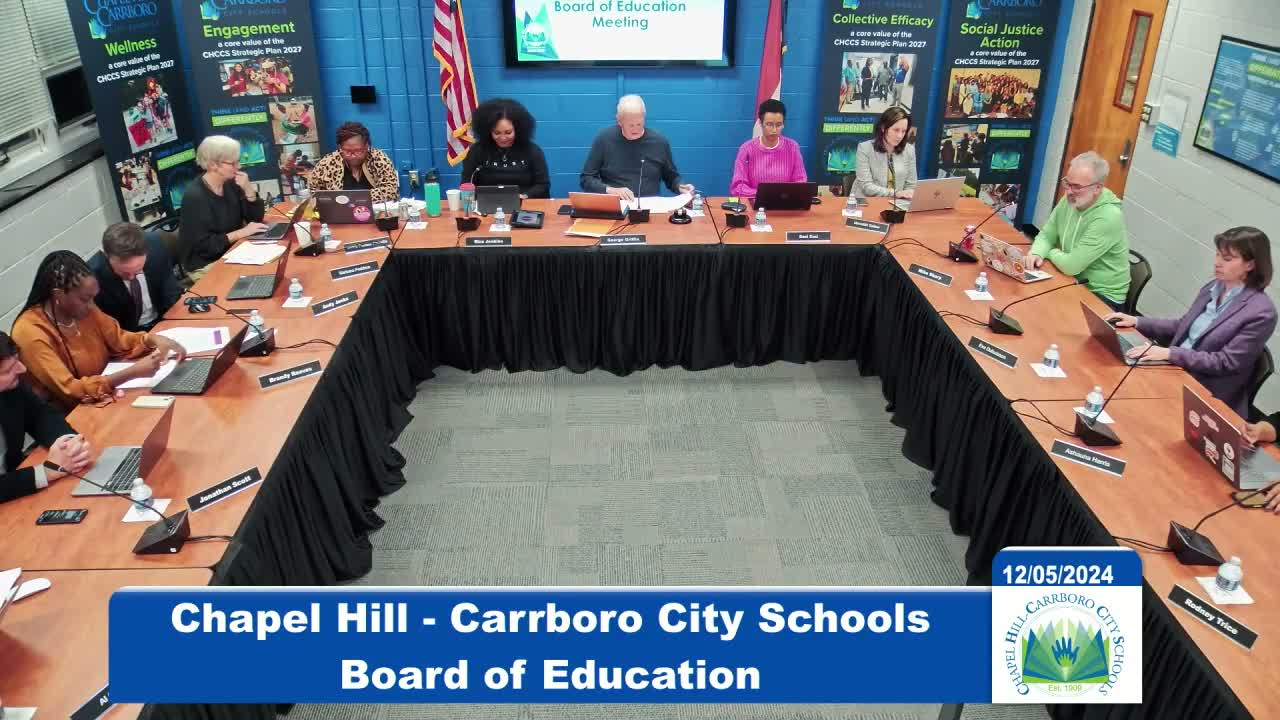
The Chapel Hill‑Carrboro City Schools Board of Education unanimously accepted the district's audited financial statements for the fiscal year ended June 30, 2024, after a presentation from the district's independent auditors.
Dale Smith, engagement partner with audit firm Anderson Smith and Weick, told the board the firm issued a clean, unmodified opinion on the district's financial statements but identified one significant deficiency in federal compliance tied to the Title I program. "We did report 1 significant deficiency related to the Title I program," Smith said, noting the district reported 16.52% of Title I spending as administration and supervision — above the 12% cap — leading to a questioned cost of $56,003.67. "DPI could request the district to repay those funds once they review the financial statements," he added.
Smith and staff described the likely cause as a payroll coding issue in which an employee remained charged to Title I rather than local funds; the district reported steps have been taken to prevent recurrence and the auditors said they will follow up in the next year's audit. Board discussion framed the finding as material for compliance but small relative to the district's overall budget: one board member said the dollar amount ‘‘gets nowhere close to even touching 1% of our whole budget."
The audit also underscored the district's low unassigned general‑fund balance. Smith reported an unassigned fund balance of negative $445,009.68 at June 30, 2024, and urged the board and administration to rebuild reserves for cash‑flow and contingency purposes. "You really don't have any money available at least within the general fund," he said, recommending aiming for a multi‑million dollar reserve consistent with commonly cited targets.
Smith reviewed other fund results: the capital outlay fund showed a modest increase in restricted balances; the school food service fund reported a net loss of roughly $359,565 for the year, driven by lower federal reimbursements and higher management fees paid to Chartwells; and the childcare fund reported a loss after a one‑time COVID grant boosted the prior year.
Board members asked staff about corrective steps and committee review; the finance and facilities committee had previously examined the issue and staff said measures are in place. After brief discussion the board moved and approved acceptance of the audit report by voice vote.
The board did not take separate action on potential DPI follow‑up; the auditors said any formal demand for repayment would follow DPI's review of the audited statements.