Get Full Government Meeting Transcripts, Videos, & Alerts Forever!
Get email alerts on the Public Safety Fireems topic
No spam. Unsubscribe anytime.
Fire chief says new rescue truck and dual-role crews improve Weslaco response
Summary
At a March 4 Weslaco workshop the fire chief laid out how EMS calls are triaged, why multiple apparatus respond to some calls and how a new Rescue 1 and cross-trained firefighter-paramedics reduce delays and improve outcomes.
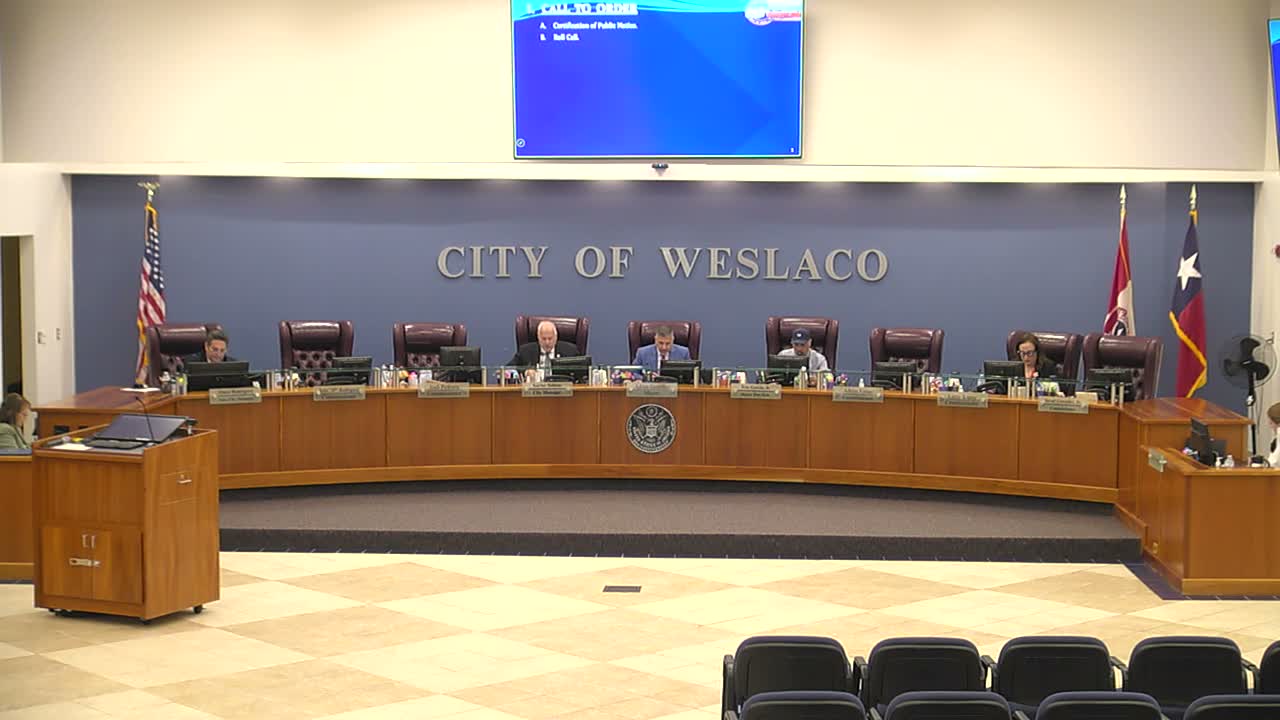
At a March 4, 2026, Weslaco City Commission workshop the citys fire chief described how the department scales responses to medical emergencies and structure fires, and why residents sometimes see multiple fire trucks at a scene.
Fire Chief Lopez told the commission that routine EMS calls—reports of difficulty breathing, weakness or noncritical ailments—typically receive a two-person medic crew, but calls that involve unresponsiveness, major trauma or multiple patients are escalated to include a fire company and additional paramedics. "We scale up," he said. "Lives first, of course, and then property second." The chief said cross-trained firefighter-paramedics aboard fire trucks can begin advanced care while an ambulance is en route.
The chief outlined how incident command works: a captain on duty becomes incident commander for larger events, additional ambulances are requested when multiple patients are involved, and mutual-aid partners (Mercedes, Elsa, Skyline and Medgear) respond when the call grows beyond local resources. He described specialized responses for brush fires—lighter brush trucks and tankers carrying up to about 2,000 gallons—and said the department has added a downtown-based Rescue 1 equipped for heavy rescue and extrication.
Police procedures for deceased-on-scene incidents were presented as a separate but coordinated process. A police supervisor explained that officers secure potential crime scenes, investigators and crime-scene units are called as appropriate, and a justice of the peace (JP) may determine whether a death is natural or requires further investigation. The supervisor said officers use privacy covers and perimeter controls to protect decedents and family privacy.
Commissioners and staff emphasized dispatchs role in correctly classifying calls. The chief warned that incorrect qualification at dispatch can send the wrong equipment and slow response; he praised dispatchers as the "first responder" because they set the initial response.
To illustrate workload, the chief noted that the department logged 28 EMS calls and 14 fire responses in a 24-hour period (42 movements) during one recent day, a figure he used to underscore the importance of staffing and equipment. Commissioners thanked staff for the explanation and said they would help inform residents about why fire trucks sometimes arrive on medical calls.
The workshop discussion closed with no formal action on policy changes; commissioners encouraged continued public outreach and training events to help residents understand dual-role crews and the citys response strategy.