Get Full Government Meeting Transcripts, Videos, & Alerts Forever!
Get email alerts on the Stormwater Utility topic
No spam. Unsubscribe anytime.
Burleson council pauses stormwater-fee push after churches urge exemptions
Summary
After staff outlined a proposed impervious‑area stormwater utility that would raise roughly $4 million annually, multiple Burleson pastors warned the fee would sharply raise utility costs for large, community‑serving congregations. Council directed staff to pause the Jan. 20 public hearing and discuss exemptions and credits at the January retreat.
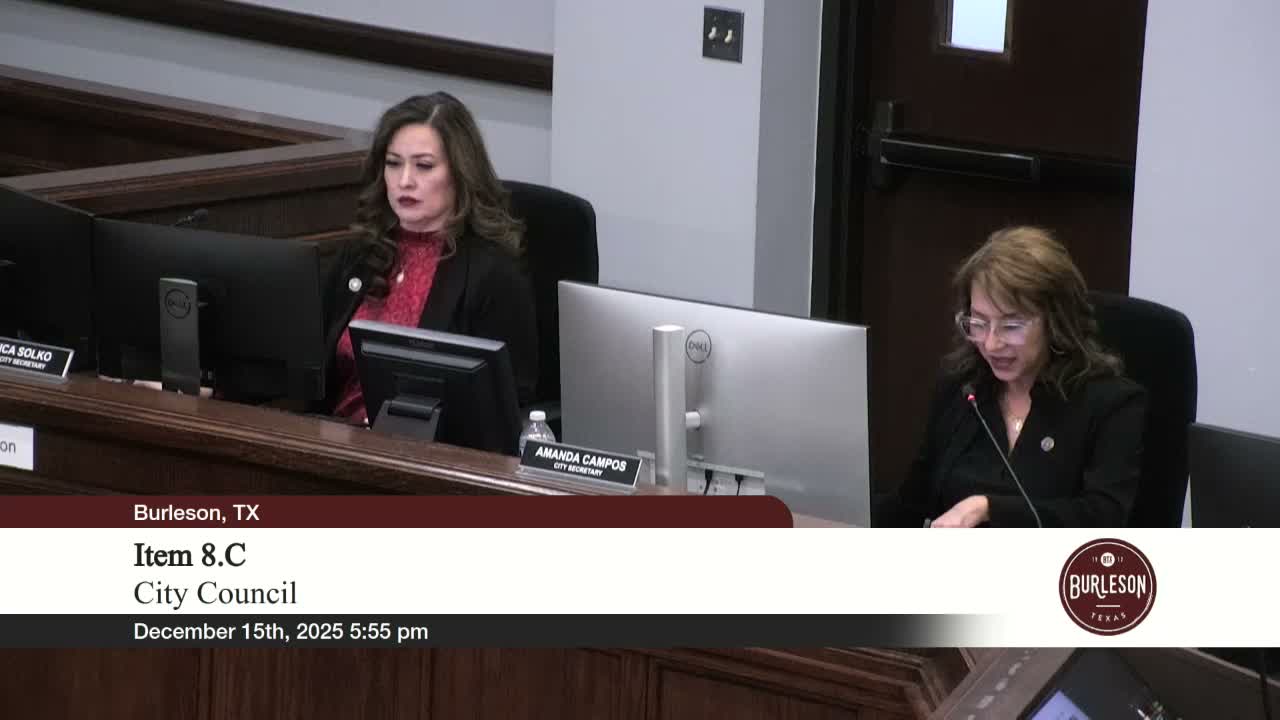
Burleson — The City Council on Dec. 15 paused notification for a Jan. 20 public hearing on a proposed stormwater utility after dozens of residents and several area pastors urged exemptions or credits for religious and community‑serving institutions.
Public Works Director Eric Thompson presented the proposal as an impervious‑area‑based utility meant to fund drainage and capital projects staff identified at roughly $146 million. Thompson said a preliminary program would generate about $4,000,000 a year and uses a three‑tier residential structure: the smallest 10% of single‑family properties would pay about $5 per month, the middle roughly 80% would pay about $8 per month and the largest 10% “would pay well over $15.” The model is based on analysis of the city’s 17,589 parcels and ties charges to measured impervious area.
“That’s not a decision we take lightly,” Thompson told the council, outlining billing integration plans for the city’s utility system and describing outreach that reached more than 26,000 people but produced 50 online survey responses.
The most immediate political pressure came during public comment. Chris Wigley, pastor at First Baptist Church, said the current preliminary calculation would add $952.91 a month to his congregation’s utility bill — $11,434.97 annually — and could force cuts to food‑pantry and counseling services the church provides. “Without an exemption we’re faced to figure out how we would come up with that amount of money each month, which would have devastating impacts to the services we provide,” Wigley said.
Other faith leaders echoed the concern and urged either a categorical exemption for religious institutions, a meaningful credit program tied to privately maintained drainage infrastructure, a phase‑in, or an appeals process. Kylan Dobbins, lead pastor at First United Methodist, proposed a verifiable credit program for nonprofit institutions that reduce runoff through detention or permeability.
Council members addressed both fiscal fairness and legal authority. Deputy City Attorney (legal counsel) explained that the enabling state law gives local governments discretionary authority to grant exemptions to certain entities — including religious institutions and public schools — but that any exemption program must be nondiscriminatory and defensible in court. Council members expressed tension between the view that “the rain falls on the just and the unjust” and the realities that many churches provide social services that otherwise fall to the city.
After listening to speakers and staff, the council voted to instruct staff not to publish the notice for the Jan. 20 public hearing and to place the item on the Jan. 26–27 council retreat agenda for additional discussion about possible exemptions, caps or alternative rate structures. Mayor (speaker 1) and multiple council members said they welcomed the faith leaders’ input and wanted more time to consider options that would protect community services while addressing long‑standing drainage needs.
What’s next: City staff will revisit the fee structure, explore exemption and credit mechanisms and present options at the January retreat; a future ordinance — if pursued — would return to council for first and second readings before any billings occur.