Get Full Government Meeting Transcripts, Videos, & Alerts Forever!
Get email alerts on the Stormwater topic
No spam. Unsubscribe anytime.
Burleson council backs tiered stormwater utility work, asks staff to refine exemptions and billing plan
Summary
City staff presented options for a stormwater utility to address $146 million of drainage needs; council directed staff to proceed with a three-tier residential structure based on a 3,500 sq ft ERU, asked for further analysis of exemptions (religious institutions and schools were discussed) and authorized billing‑integration work to be funded via a March contract/budget amendment.
City of Burleson staff led a lengthy discussion Jan. 18 on a proposed stormwater utility designed to provide dedicated revenue for drainage maintenance, regulatory compliance and capital projects.
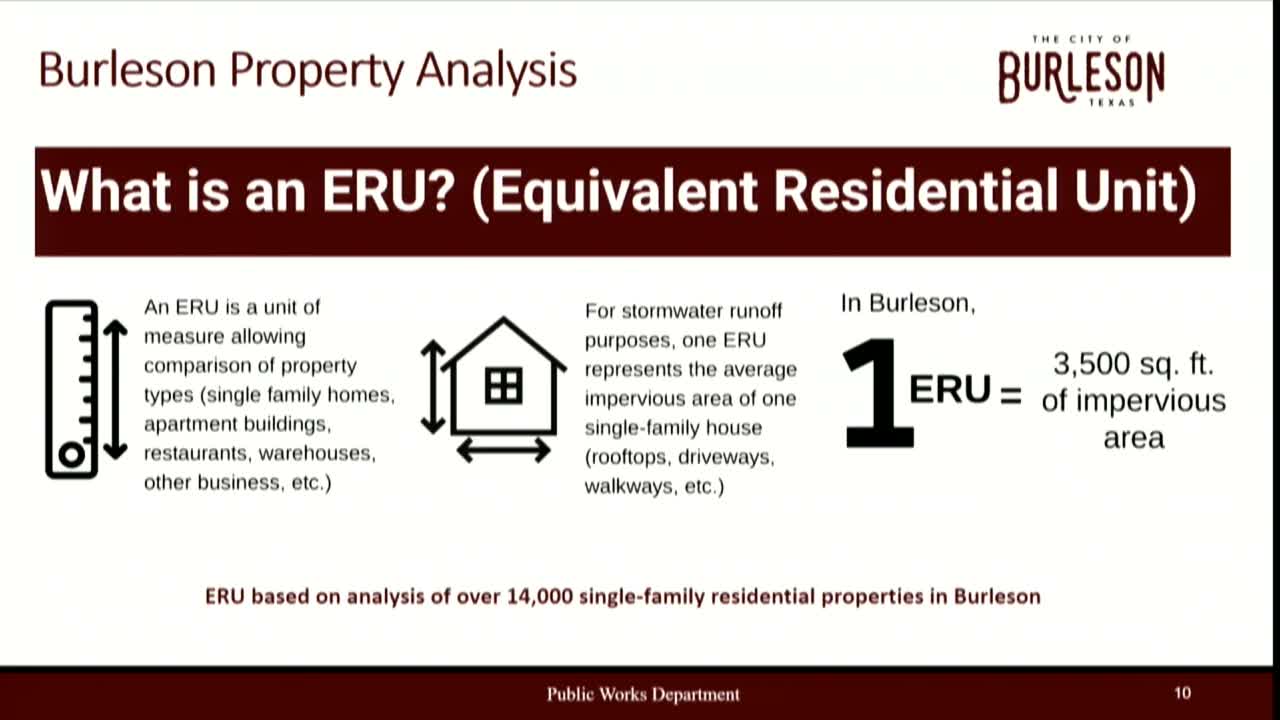
Public Works Director Eric Thompson said staff and consultants had analyzed every parcel in Burleson to estimate impervious area and set an Equivalent Residential Unit (ERU) at about 3,500 square feet. Using that ERU, staff presented a preliminary program sized to generate roughly $3.7–4.1 million annually; the baseline residential charge shown in staff materials was about $8 per ERU per month. To reduce the burden on smaller lots, staff proposed a three-tier residential structure (roughly 10% smallest properties, 80% mid-sized, 10% largest) that in examples would yield rates near $4.94 (small), $8 (middle) and $15 (large) per month under one scenario.
Thompson emphasized program components: (1) a maintenance crew and equipment to raise routine service levels, (2) a capital component for priority drainage projects, and (3) compliance activities required by state stormwater permits. He told council staff estimated the community faces an extensive list of unfunded drainage needs and that a dedicated funding source would allow planned, prioritized work rather than continuing to shift tasks between other budgets.
Council members, staff and many citizens focused on fairness and exemptions. Several residents and local church representatives asked whether religious institutions and school districts would be exempt. Thompson outlined state-law limits and said the council has discretion on some exemptions; he warned that exempting classes of properties would either reduce program size or raise per‑unit rates for remaining payers. Council members expressed different views: some favored a full move forward with the tiered structure and no school exemptions; others sought a modest reduction or nominal charge for small religious institutions. Staff provided an estimate that fully exempting local religious organizations would increase the ERU rate only slightly (roughly $0.20 per ERU in the model staff presented) if the program size were held constant.
Council consensus: proceed with a tiered residential structure and direct staff to return with implementation details. Staff said next steps include a contract/budget amendment in March to pay for billing‑integration work with the city’s utilities/billing vendor and partner agencies, public outreach including test bills and public hearings in late summer, and ordinance readings in late summer to enable October billing if the council adopts the fee at that time.
What remains unresolved: final ERU/fee choices, whether and how to treat religious organizations and school districts (several councilors said they do not want to exempt schools), and details of a credit program for private stormwater controls. Staff will run scenarios reflecting exemptions and reduced program sizes and return with recommended language and an exact schedule for hearings and adoption.
Quote: "We have a $146,000,000 list of unfunded drainage needs," Eric Thompson said, arguing a dedicated revenue source would allow prioritized, durable work rather than temporary fixes.
Next steps: staff will return in March with a proposed contract amendment to fund billing work and will refine exemptions and public-outreach plans ahead of a possible August–September hearing schedule.