Get Full Government Meeting Transcripts, Videos, & Alerts Forever!
Get email alerts on the Housing Missing Middle topic
No spam. Unsubscribe anytime.
Governance Committee approves study of incentives for missing-middle housing in San Antonio
Summary
The Governance Committee voted to approve staff recommendations to study and develop a program offering technical assistance, permit-ready designs and possible fee waivers or abatements to spur "missing middle" housing; staff will return recommendations to the Planning and Community Development Committee and align changes with the 2027 UDC amendment cycle.
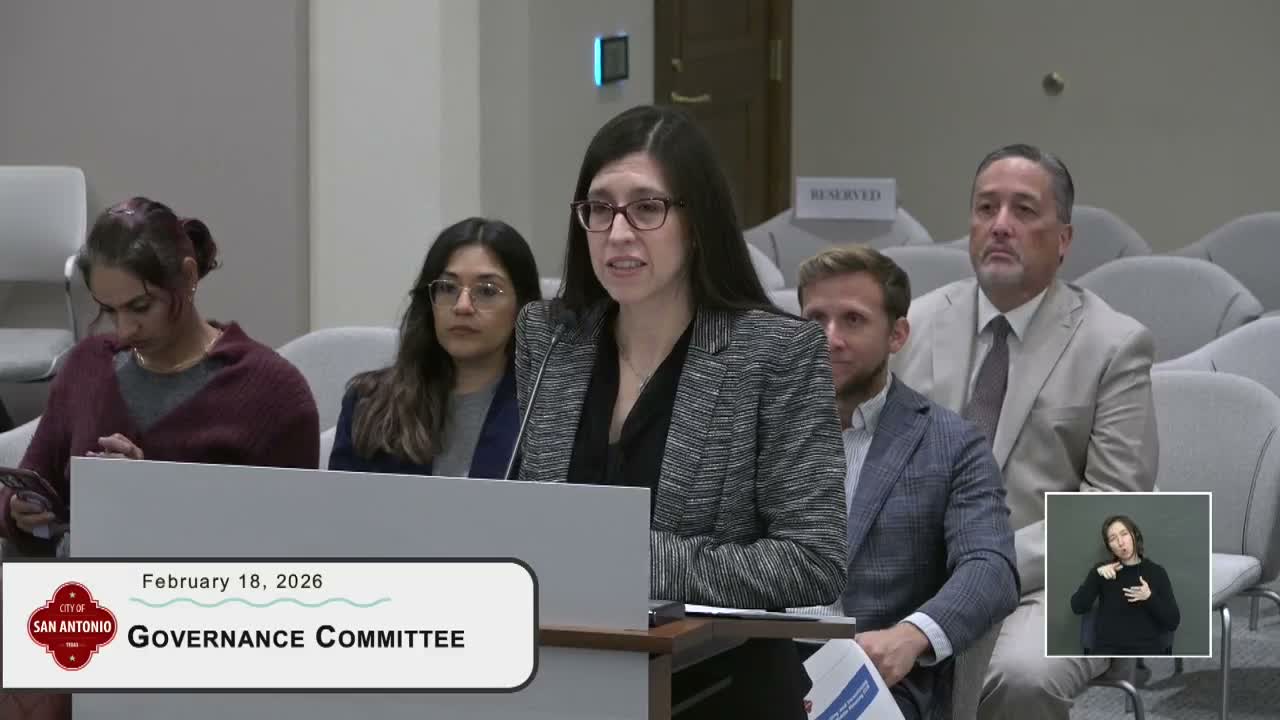
The Governance Committee voted to approve staff recommendations to study and develop a program to support and incentivize missing-middle housing in San Antonio after a presentation by Veronica Garcia, director of the Neighborhood and Housing Services Department.
The program concept, submitted as a council consideration request on Jan. 27 by Councilwoman Core, would study and potentially create targeted incentives such as predevelopment assistance, a single point of contact for technical help, permit-ready designs compatible with historic and conservation districts, and financial tools including SAWS impact-fee waivers, property tax abatements, grants or low-interest loans. Garcia told the committee, "Missing middle housing is a range of multi unit housing types really between single family housing and large multi family apartment complexes." (Veronica Garcia, director, Neighborhood and Housing Services Department)
Councilman Court, the bill sponsor, said the effort grew from local conversations and recent planning work. "As you may know, in the urban core, we just had a meeting yesterday... there are a lot of families that are moving out of the urban core, and we have to continue to create more housing options," he said, arguing the city needs housing types that fit between single-family homes and large apartment projects. Court highlighted inconsistent Development Services (DSD) responses developers receive during permitting and urged a designated city point person to streamline those cases.
Council discussion focused on design, scale and fiscal trade-offs. The chair raised concerns about foregone property-tax revenue from abatements and questioned whether duplexes and triplexes alone would provide the density needed for long-term housing goals. Garcia responded that many peer cities began by allowing multiple units by right on single lots and by streamlining permitting; she also said consultants are analyzing UDC barriers and that any UDC recommendations would be coordinated with the Housing Commission's removing-barriers subcommittee and the 2027 UDC amendment cycle. Mark Carmona noted recent state legislation made commercial-to-housing conversions easier but did not materially change single-family lot rules.
Council members suggested targeting areas surrounding downtown where missing-middle typologies are most feasible and emphasized quality standards so newly built units do not remain vacant. Veronica Garcia said affordable missing-middle projects can already apply for existing incentives but that smaller projects face financing and economies-of-scale challenges. She recommended continuing study and developing cost estimates and implementation options; staff will present formal recommendations to the Planning and Community Development Committee.
A motion to approve the staff recommendations was made and seconded; the chair declared the motion passed. The committee adjourned at 10:28 a.m.