Get Full Government Meeting Transcripts, Videos, & Alerts Forever!
Get email alerts on the Committee Vote Roundup topic
No spam. Unsubscribe anytime.
Ways and Means Committee advances package of bills, including heirs‑protection program and limits on student‑data sharing
Summary
The House Ways and Means Committee advanced multiple bills across education, housing and tax policy, amending several measures and moving them forward favorable; the session included extended debate and a roll‑call on a heirs‑protection program that sets grant and eligibility parameters.
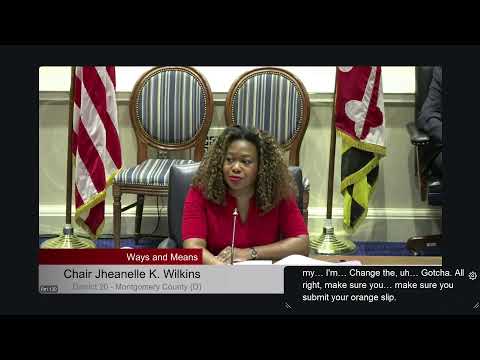
The House Ways and Means Committee, chaired by Janelle Wilkins, advanced a slate of bills in a brief Friday voting session, moving measures on education, housing and tax policy forward for consideration by the full House.
Among the bills the committee advanced were HB 96 (amended), HB 222 (naloxone education and limited student authorization), HB 288 (state superintendent emergency authority for virtual instruction, amended), HB 293 (limits and reporting for Maryland Longitudinal Data System Center data‑sharing), HB 363 (authorizing local child tax credits as grants funded by counties), HB 717 (extending Baltimore City raffle authorizations), HB 936 (school food procurement targets in Montgomery County), HB 1110 (notice in judicial in‑rem tax foreclosures), HB 1148 (legacy/heirs protection program, amended and advanced after a roll call), and HB 1554 (a study on exempting farm electricity from sales and use tax).
Delegate Delia Ebersole, sponsor on several items, described HB 293's amendments as tightening privacy controls and requiring written data‑sharing agreements and annual reporting. "The amendments limit the number of agreements with third party data systems that the center can enter into to one," she said, and added the bill requires the center to report to relevant legislative committees within 30 days of entering such an agreement.
Privacy concerns surfaced during debate on HB 293. "I'm not gonna vote for this bill because I think that it perhaps is starting to reach the point where it's going a little bit too far," Delegate Dahlia Buckle said, citing worries about expanding data collection without demonstrated outcomes.
On HB 288, which allows the state superintendent to declare a prolonged state of emergency that can trigger virtual instruction, Delegate Delia Young asked whether local jurisdictions would have a formal mechanism to respond if they disagreed with a superintendent's decision. Sponsors said the amended language requires consultation and a written declaration and allows the emergency to be lifted by joint resolution, the state board, or the superintendent.
The committee also debated HB 1148, creating a legacy protection program to help heirs complete probate and become record title holders. Council staff told the committee the program's total funding would be $750,000, with counties contributing $500,000 collectively and the state $250,000; the bill raises the eligible home value cap to $450,000 and delays the program's effective date to July 1, 2027. After extended discussion on eligibility criteria and funding, the committee advanced the bill with amendments on a roll‑call.
Several bills passed by voice vote after demonstrated motions and seconds; the committee adopted a consent calendar to withdraw a set of bills sponsors had pulled. Chair Wilkins closed the session and said the committee will reconvene on Monday.
The committee's actions advance multiple pieces of legislation but do not themselves enact policy; each bill will proceed through subsequent floor consideration and committee review as required.