Get Full Government Meeting Transcripts, Videos, & Alerts Forever!
Get email alerts on the Adu Policy topic
No spam. Unsubscribe anytime.
Generational Housing Act proposes statewide ADU standards and tax incentives to ease multigenerational living
Summary
House Bill 15-38 would require local jurisdictions to allow at least one internal and one external accessory dwelling unit on single-family lots, provide property‑tax exemptions for ADUs occupied by qualifying family members, and limit utility capacity fees; supporters said ADUs help aging parents, childcare and affordability and urged a favorable report.
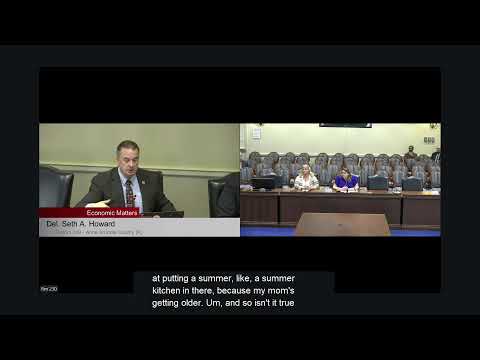
Delegate April Miller presented House Bill 15-38, billed as the Maryland Generational Housing Act. Miller said the bill creates a statewide standard requiring jurisdictions to allow at least one internal and one external accessory dwelling unit (ADU) on single‑family lots, provides a property‑tax exemption when an ADU is occupied by a qualifying family member (parent, grandparent, child, grandchild or sibling), and restricts utility capacity fees and certain development excise taxes for qualifying ADUs.
Miller framed the bill as addressing the "missing middle" of housing and enabling multigenerational families to live together affordably — a solution for caregiving and cost pressures. Supporters included Andrea Maxey, who described using an ADU to house family after a loss, and Mark Clements of Greater Greater Washington, who said the bill builds on last year’s ADU law and would expand housing options and affordability.
Committee members asked technical questions about interior versus exterior ADUs, impact fees, septic and permitting complications for some counties, and whether the 2025 law (HB 1466) already covered exterior ADUs. Witnesses said the bill would allow internal ADUs that currently are feasible but expensive, and that the bill’s tax and fee incentives are intended to make interior ADUs affordable.
The hearing closed after several minutes of questions and no recorded opposition that day. The proposal would alter local development fee structures and tax treatment to encourage family-occupied ADUs if enacted.