Get Full Government Meeting Transcripts, Videos, & Alerts Forever!
Get email alerts on the Economic Development topic
No spam. Unsubscribe anytime.
Senate president urges Maryland Future Fund to target industries and partner with universities
Summary
Senate President told the Economic Matters Committee SB 770 would create a Maryland Future Board in the Department of Commerce to guide targeted investments and direct the comptroller to partner with the University System of Maryland on an industry-growth study to inform strategic spending.
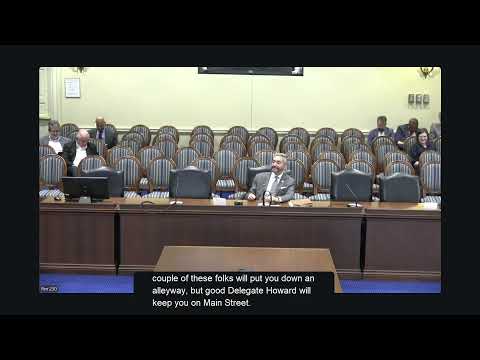
Senate President presented Senate Bill 770, the Maryland Future Fund, to the Economic Matters Committee, saying the measure would create a Maryland Future Board inside the Department of Commerce to make targeted investments in industries where the state has competitive advantages. "We need to have a more structured plan about what the future looks like and where we are investing our precious and limited resources," the Senate President said in opening remarks.
The sponsor framed the bill as a response to shifting federal spending patterns and private-sector growth in industries such as aerospace, which he noted supports roughly 172,000 jobs tied to federal contracts and institutions such as NASA and the Department of Defense. He said the legislation is designed to move Maryland from an ad-hoc investment approach to one that aligns capital with sectors likely to generate revenue and jobs for the state.
A key amendment described during the presentation would authorize the comptroller's office to partner with the University System of Maryland — including institutions such as the University of Maryland, College Park, Salisbury, and Towson — to produce disaggregated industry analyses that the sponsor said are necessary to make evidence-based investment choices. "We don't have the capacity to look at industries in terms of opportunity for future revenue growth," the sponsor said, arguing the study would help set priorities.
Committee members pressed the sponsor on how SB 770 would differ from existing economic-development players such as TEDCO or the Department of Commerce and whether the bill would consider workforce and education infrastructure needs. A committee member asked whether the proposal would address school infrastructure tied to industry training; the sponsor pointed to recent private-sector activity (the McCormick acquisition) as an example of changing regional labor demands and said the fund would be one piece of a larger strategy to ensure Maryland schools and apprenticeship programs align with employer needs.
The committee closed the hearing on SB 770 with no recorded vote and no further witnesses. The bill will proceed through the committee process for further consideration and amendment.