Get Full Government Meeting Transcripts, Videos, & Alerts Forever!
Get email alerts on the Intergovernmental Partnerships topic
No spam. Unsubscribe anytime.
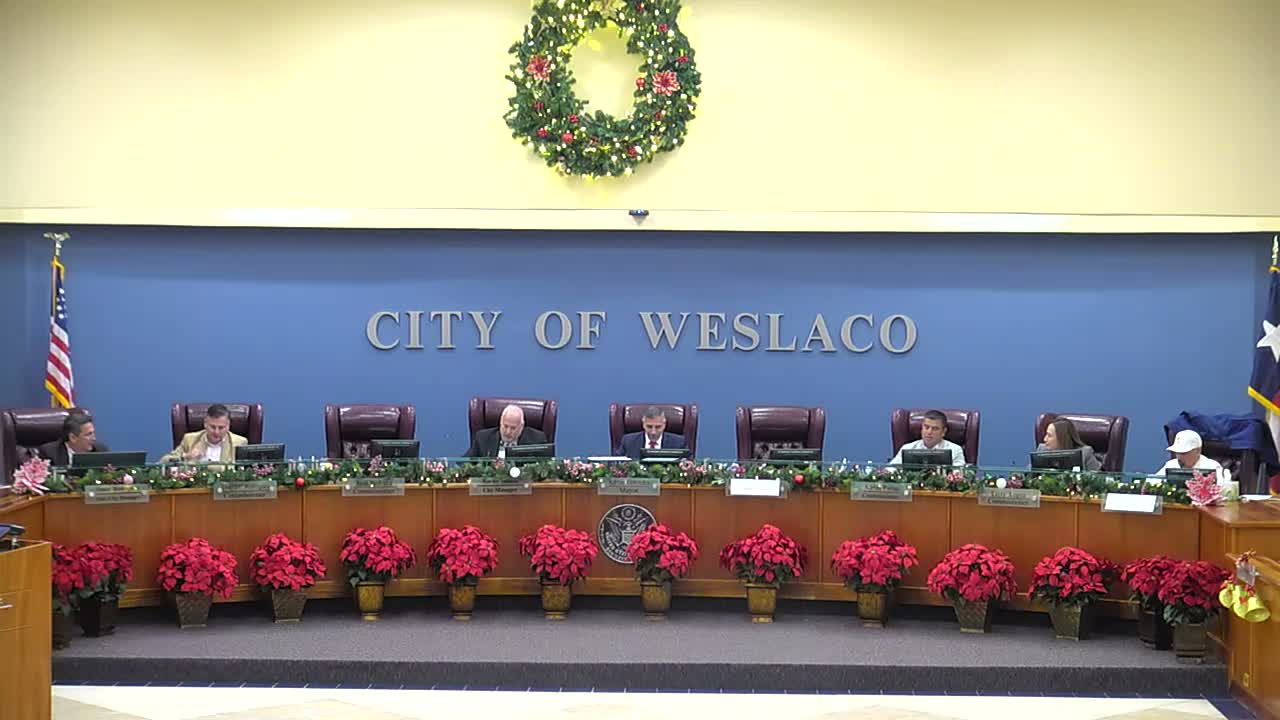
Inframark pitches IGSA partnerships to Weslaco commission as a potential revenue stream
Summary
Inframark representatives briefed the commission on intergovernmental support agreements (IGSAs), explaining how municipalities can provide public-works services to military installations under Title 10/NDAA rules to generate guaranteed revenue without burdening city staffing.
Brian Logan of Inframark told the Weslaco City Commission that intergovernmental support agreements, or IGSAs, let municipalities partner with nearby military installations to provide public-works services — and, in doing so, capture a guaranteed revenue stream for the city while lowering federal contract overhead.
"IGSA" stands for "intergovernmental support agreements," Logan said, tracing the model’s origin to the City of Monterey in 1995 and noting it was codified in federal law and regulations via the National Defense Authorization Act in 2013. He described a broad catalog of work that can be performed under IGSAs — from wastewater and water-tower maintenance to paving, landscaping, and street sweeping — and said many contracts run five to ten years, with proposals in Congress to extend some to 20 years.
Logan said municipalities can earn recurring revenue without taking on existing city workloads. "The city actually takes that cut of revenue," he said, adding that Informark typically provides the program manager and workforce so the city's departments are not required to supply staff or equipment. He cited the City of Hinesville and Fort Stewart as a case in which local execution of services produced measurable revenue and long-term contract re-executions.
Commissioners asked whether the IGSA model would replace local departments; Logan said the partnerships are generally supportive and can be configured so existing city programs continue unchanged. He advised that the next step would be for city staff (city manager, assistant city manager and finance director) to meet with Inframark to scope potential opportunities and costs.
Logan estimated typical IGSA contract sizes "just under $5,000,000" and said the municipality's guaranteed revenue percentage usually ranges from 3% to 5% of contract income, though specific terms vary by arrangement. He also described an average development timeline of roughly 180 days from agreement to execution.
Commissioners signaled interest in exploring IGSA options at an upcoming retreat in January, and staff and Inframark representatives agreed to follow up with a more specific plan and cost estimates for commission review.
The commission then moved into executive session later in the workshop.