Get Full Government Meeting Transcripts, Videos, & Alerts Forever!
Get email alerts on the Gambling Regulation topic
No spam. Unsubscribe anytime.
Delegate Patterson’s bill would modernize electronic bingo rules, industry urges modest increases and paper‑ticket rollback
Summary
House Bill 15-87 would modernize Maryland’s electronic instant bingo law: allow modest increases in machines at licensed facilities in Anne Arundel and Calvert counties, repeal an outdated cap and remove the requirement to print a paper ticket for every game. Industry witnesses said the changes would reduce waste, support jobs and generate state and local revenue; the committee paused before voting.
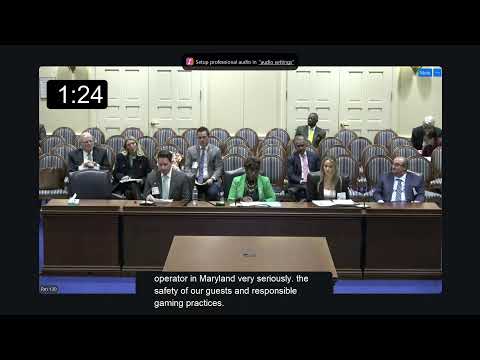
Delegate Edith Patterson, sponsor of House Bill 15-87, told the Ways and Means Committee the bill "is a modernization bill that updates Maryland's bingo laws to reflect how the industry operates today and removes a regulatory constraints that no longer serve a meaningful public purpose." She said the measure would repeal an outdated limit on electronic bingo cards, allow a modest increase in the number of machines at certain licensed facilities in Anne Arundel and Calvert counties, and eliminate the requirement that machines print a paper ticket for every game while preserving vouchers required for prize redemption.
Industry witnesses supported the bill. Jerry Evans, who said he has represented the bingo industry for more than 20 years, told the committee the machine cap (frozen on Feb. 28, 2008) has constrained community bingo halls while the broader gaming market has expanded: "Maryland's broader gaming market has expanded enormously since 2008... casinos now operate a combined total of approximately 11,500 slot machines," he said, and argued that allowing modest increases would help small halls remain viable. Evans also called the paper-ticket requirement "wasteful, costly, and environmentally burdensome."
Operators reported local economic impacts and staffing numbers. Nathan Benefiel of Arundel Amusements Inc. (Bingo World) said the bill would ease operational costs at his Brooklyn Park facility and help the business remain competitive. Mary Lanham, owner and president of Chesapeake Amusements (Rod and Roll Bingo), described multigenerational operations and said passage would allow hiring of about 50 additional employees and protect the family business. Emma Weinstein of Atlantic Bingo summarized Legislative Services projections cited by witnesses: passage would yield an additional $8,900,000 in state general fund revenue annually and $2,200,000 in state special funds; the transcript also records local revenue increases including "$253,000 for Calvert County" and an Anne Arundel figure given as "1.8" with units not specified in the hearing record.
Witness Craig Romack of Delta Bingo and Gaming noted a fiscal contribution to the state in fiscal year 2023 (transcript: "$20,000,000") and reiterated that operators intend to work with the committee to find an appropriate machine cap. Sushant Sid urged the committee to consider casino capacity when assessing any opposition, saying casinos were authorized to operate up to 16,500 machines and currently operate about 9,000, leaving a delta of roughly 7,500.
Sponsor and industry witnesses emphasized that the bill does not create new bingo facilities, change the fundamental nature of the game, convert bingo machines into slot machines, or require a constitutional referendum. The committee fielded a question from member Delia Buckle about whether a doubling of machine limits was necessary; witnesses said they were willing to work with the committee on the degree of increase.
The committee paused for a five-minute break before voting on the slate of bills; no formal vote on HB 15-87 was recorded in the transcript.