Get Full Government Meeting Transcripts, Videos, & Alerts Forever!
Get email alerts on the Labor Contracts topic
No spam. Unsubscribe anytime.
Wesicoll negotiators agree to exchange proposals on 48/96 pilot, expedited hiring and budget impacts
Summary
At a Sept. 3 bargaining session, city negotiators and the Wesicoll Firefighters Association discussed a proposed 48/96 shift pilot, options to fast‑track six vacancies through a civil‑service addendum, and preliminary city cost estimates; both sides set homework and will meet Sept. 10.
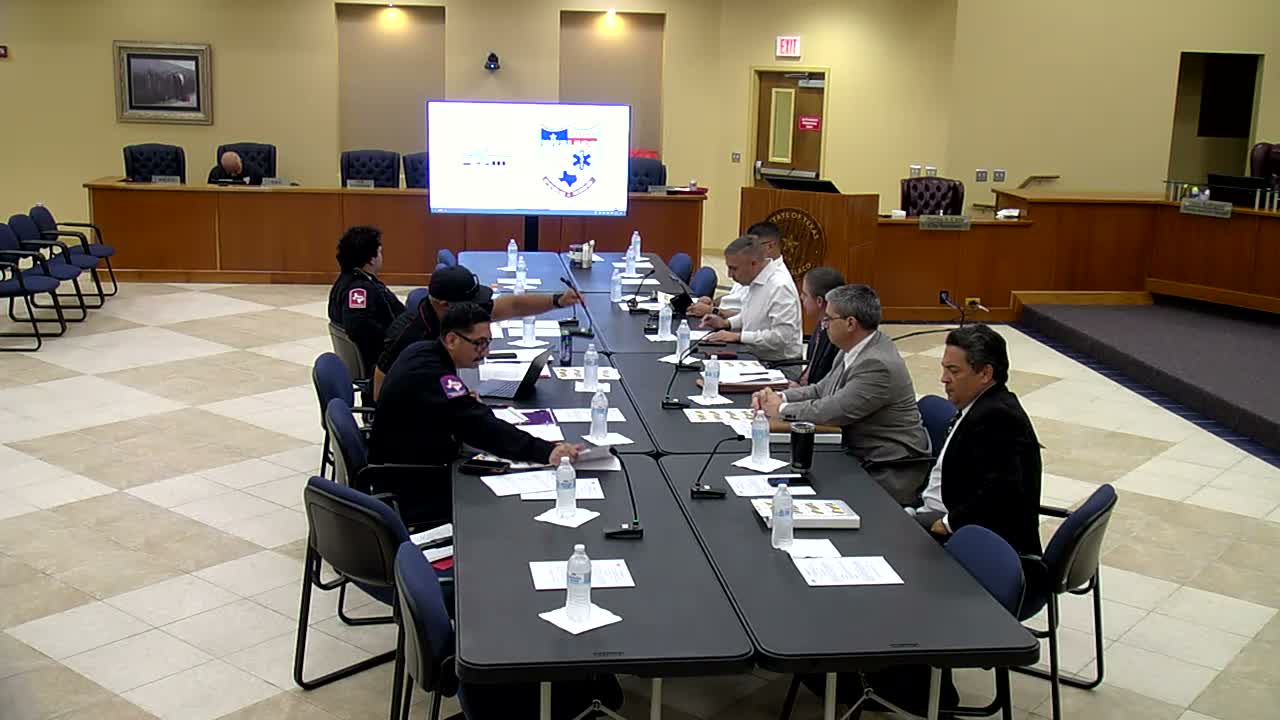
The Wesicoll City Commission’s negotiating team and representatives of the Wesicoll Firefighters Association met Sept. 3 to continue talks over a new collective‑bargaining agreement, focusing on a proposed 48/96 work schedule pilot, the city’s multi‑step hiring process and the budgetary impact of the union’s proposals.
The session opened with thanks for recent fire‑suppression efforts near city hall. Chair then read the agenda and identified the item as ‘‘discussion, consideration, and negotiation for the purpose of collective bargaining’’ under chapter 174 of the local government code. A city negotiator laid out ground rules for ‘‘orderly, good‑faith bargaining’’ and warned the statutory negotiation window is nearing its end.
City staff presented a detailed 17‑step hiring timeline that includes civil‑service posting and testing, background and psychological checks, a 16‑week academy and a 10‑week EMT course. Staff said those steps — and windows for academy/EMT seats and reciprocity processes — can stretch total onboarding to roughly a year. ‘‘It’s not a simple matter of the city desiring this deciding, well, we’re gonna hire somebody and that person starts within a week or two,’’ the Staff member said during the presentation.
Fire Department leadership explained the department’s current ISO scoring and staffing profile. The Chief said Wesicoll scored roughly 30 of 50 possible fire‑department points in its ISO audit and noted that station placement and manpower are the largest remaining opportunities to improve that score. The Chief described a full roster as 23 personnel per shift and said the department currently shows six vacancies that reduce operational capacity.
Much of the meeting centered on the association’s proposal to pilot a 48/96 schedule (48 hours on, four days off). The union representative said the schedule ‘‘lets your body rest for four days’’ and proposed a six‑month pilot. City negotiators and commissioners repeatedly pressed for objective data: call‑in and sick‑leave rates, comparative experience from other agencies, and parameters to limit fatigue and operational risk.
‘‘It seems counterintuitive … rather than being a fatigue‑saving device, you’re gonna go from somebody working 24 hours straight to 48 hours straight,’’ a Staff member said, urging safeguards and clear metrics commissioners could use to evaluate a pilot. Multiple committee members asked the union to propose contract language that would set monitoring metrics, off‑duty limitations and a sunset or pull‑the‑plug clause if the pilot increases overtime or sick leave.
Union leaders responded that many members already work extended hours because of overtime and that a formal 48/96 schedule could reduce unscheduled call‑ins by providing predictable rest blocks. The union said most members do not hold second jobs and that existing contract language already requires 24 hours of rest before a shift.
Recruitment and retention were also central. City staff reviewed preliminary cost figures for the association’s earlier‑stated proposals, including a three‑year plan to add six firefighters per year. Staff presented preliminary aggregate estimates they said could reach approximately $3.3 million over the contract term for multiple proposed items, and finance staff gave an illustrative figure of about $261,282 in year‑one city costs to add six firefighters (including attendant employer costs beyond base pay).
Given hiring timelines tied to civil‑service procedures, the city proposed negotiating a temporary mutual addendum — modeled on a prior police addendum — to prioritize certified candidates and accelerate onboarding for the six current vacancies, with an automatic sunset tethered to when those vacancies are filled. The association signaled willingness to consider such targeted, time‑limited language.
Both sides left the meeting with homework: the union will provide a written proposal and expected membership response on the 48/96 transition and the specific seven outstanding contract articles (including articles 13, 22, 26, 29, 33, 34 and 35); the city will return a full fiscal picture for all costed items and suggested language to modify elements of Chapter 143 civil‑service steps for a limited period. The parties agreed to reconvene Sept. 10 at 5 p.m.
No formal motions or votes were taken during the session; negotiators characterized the meeting as an information‑exchange and a step toward exchanging formal proposals at the next meeting.