Get Full Government Meeting Transcripts, Videos, & Alerts Forever!
Get email alerts on the Drainage Infrastructure topic
No spam. Unsubscribe anytime.
Weslaco staff outline drainage shortfalls, propose study and $13.3M of candidate projects
Summary
City staff showed undersized drainage crossings in older neighborhoods, said a 30‑inch pipe can carry roughly 11 times the flow of a 12‑inch pipe, proposed a citywide drainage study and presented roughly $13.3 million in candidate projects and a list of 11 locations not included in earlier studies.
City staff on Tuesday urged the Weslaco City Commission to prioritize drainage upgrades in older neighborhoods, presenting pipe samples, maps of problematic crossings and a list of candidate projects that staff estimated could cost roughly $13.3 million.
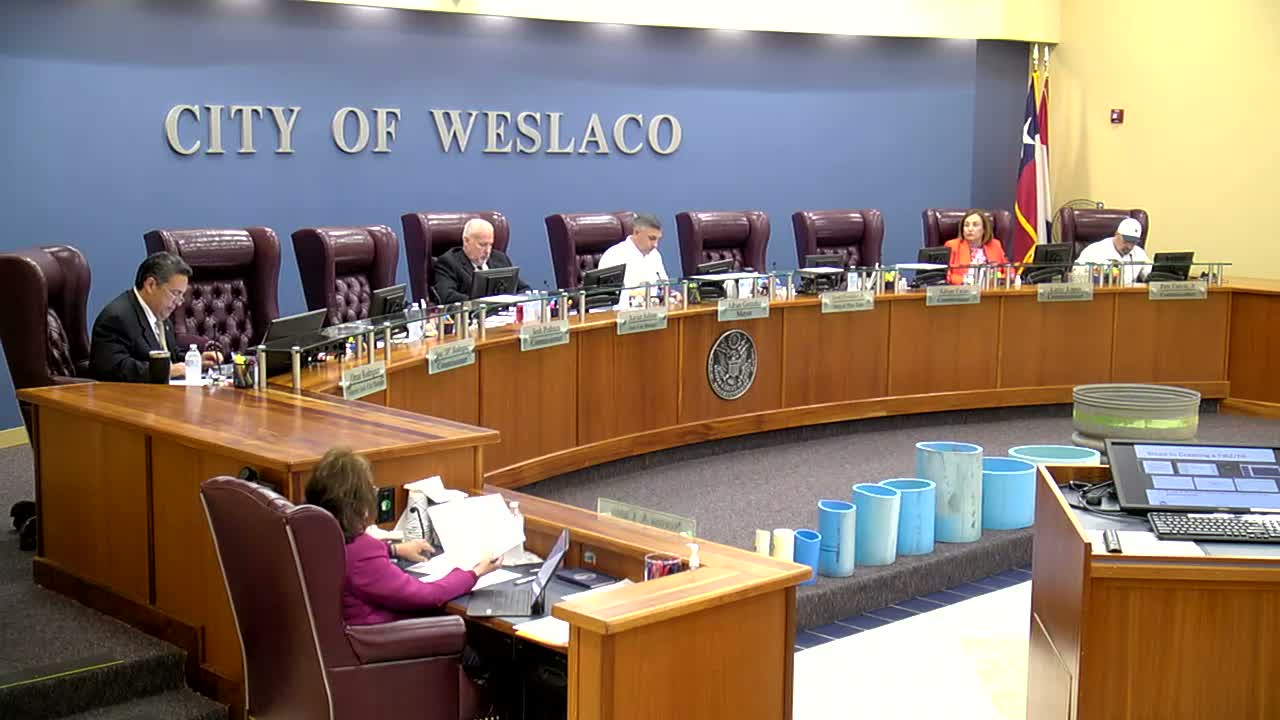
What staff presented: Peter (city staff) and David walked commissioners through the definition of a drainage “crossing” (an open ditch connected to an underground pipe and an outfall ditch) and said many older parts of town still rely on 6‑ to 12‑inch pipes. Staff highlighted that, hydraulically, a 30‑inch pipe can handle roughly 11 times the flow of a 12‑inch pipe, which is a primary reason to upsize critical conveyance lines rather than merely replacing like‑for‑like.
Scope and study recommendation: Staff identified 11 projects not included in the city’s 2018/2019 HAF drainage study and recommended commissioning a new citywide drainage study (staff described the recommendation as consistent with market rates for cities of similar size; a specific contract amount was not provided in the workshop). Staff also presented site maps, parcel IDs and suggested prioritization methods, noting some problem locations were already known to residents and commissioners.
Maintenance and equipment: Commissioners asked how the city would maintain larger conveyance structures; staff said the city plans to pursue a vacuum truck dedicated to storm‑drain cleaning and has procured a pipe‑inspection camera van to inspect systems before accepting work from contractors. Those tools are intended to reduce sediment and debris that otherwise degrade capacity.
Coordination and funding: Commissioners discussed coordination with TxDOT for crossings under state right‑of‑way (for example along frontage roads) and the need to verify elevations and downstream outfall capacity before completing overlays or upsizing pipes. Mayor Gonzales said he would participate in a regional panel with the Texas Water Development Board and state lawmakers to pursue grant funding and regional allocations; he identified an estimated $2 billion regional water package in discussion at the state level as a possible funding source.
Next steps: Staff recommended moving forward with a new drainage study, incorporating the identified projects into capital programming, and coordinating overlay work with drainage upgrades to avoid cutting newly paved streets. Commissioners did not take a vote at the workshop but asked staff to return with further details and cost estimates.