Get Full Government Meeting Transcripts, Videos, & Alerts Forever!
Get email alerts on the Sanitation topic
No spam. Unsubscribe anytime.
Weslaco public works outlines truck shortages, maintenance costs and new AI routing system
Summary
Public Works staff told commissioners the sanitation program has grown to roughly 13,000 residential accounts and about 750 commercial accounts, described aging trucks and rising maintenance costs, and demonstrated a newly installed AI camera/routing system that staff say will improve route accuracy and provide mileage, fuel and tonnage data after a trial period.
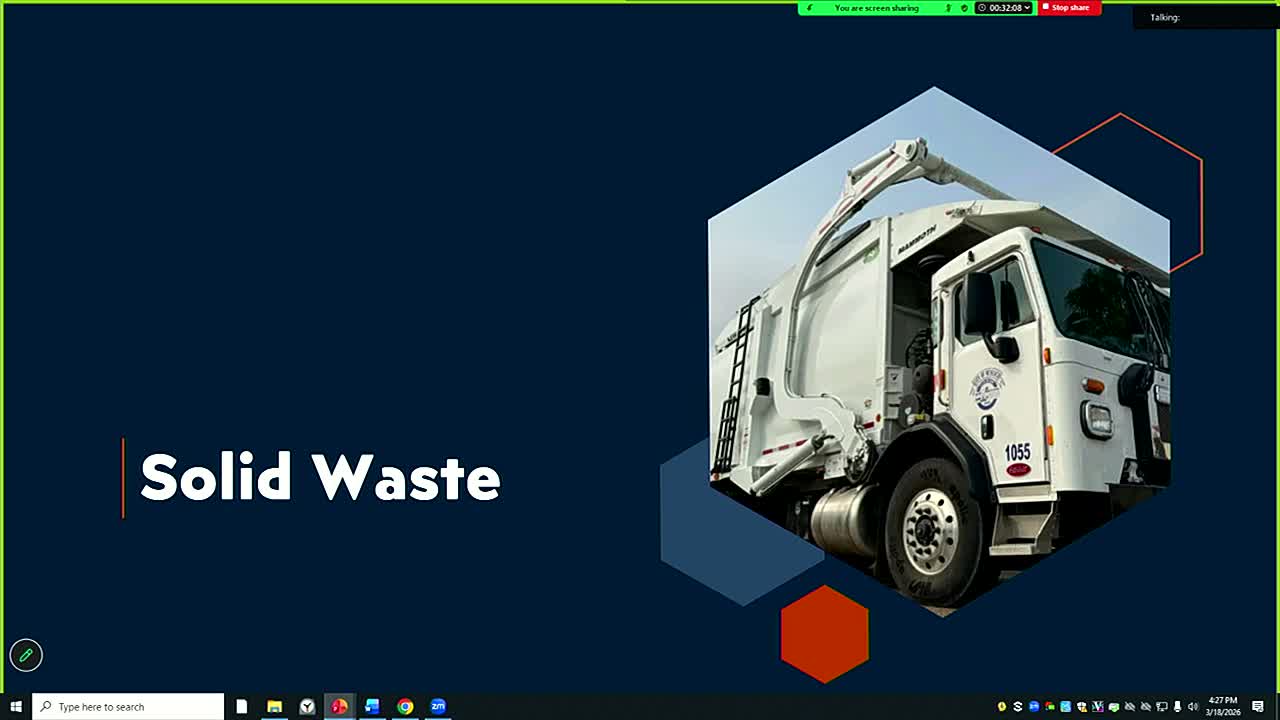
Nick, a Public Works representative, presented a detailed briefing on the City of Weslaco’s solid waste operations at the workshop, outlining fleet and staffing numbers, maintenance costs and a newly installed routing and camera system intended to improve service accuracy and reporting.
Nick said the city’s residential accounts have risen from about 10,560 in 2021 to roughly 13,000 today, while commercial accounts increased from about 650 to about 750. He described the current fleet as having six commercial trucks and seven residential trucks (two identified as spares) and said drivers average about 150 miles per day on heavy pickup days. “We have not replaced any of the trucks,” Nick said, and presented maintenance cost examples including an estimated $79,000 annually to replace tires for the fleet, $23,000 for tire repairs, a $17,000 cylinder replacement and an $11,000 fuel pump replacement for one unit.
Nick compared Weslaco’s residential fee — presented as $15.05 for one trash can with two weekly pickups — with neighboring cities (Donna and McAllen) and noted Weslaco currently does not charge a 'go‑back' fee for missed pickups. He said the department is conducting a rate study to evaluate expenditures and align rates with service costs and asked the commission to consider a multi‑year replacement plan for trucks.
Armando “Mando” Torres, the sanitation analyst, demonstrated the recently installed routing system and AI cameras mounted on trucks. The system captures images when a can is not put out, matches the photo to an address and can automatically generate a customer notice. “The new system... will make drivers about 90% hands‑free from the tablet,” Mando said, and staff said the system will also, after a month of data collection, provide per‑route mileage, fuel usage and tonnage reports.
Commissioners asked for more granular reporting (tonnage by route; tonnage by first vs. second pickup) and discussed operational improvements: cross‑training roll‑off drivers to cover residential and commercial routes, using temporary CDL drivers to cover absences, exploring a substitute list of retired drivers, and examining a local transfer station to reduce haul time and truck wear. Staff said the manager’s office and public works will develop a five‑year plan to identify replacement needs and possible transfer‑station options.
The workshop concluded with a motion to go into executive session, which passed by voice vote, followed by adjournment of the workshop and a transition to the regular meeting.
Next steps: staff will return with the rate study findings, replacement program proposals and requested per‑route tonnage and mileage data once the new routing system has collected sufficient data.