Get Full Government Meeting Transcripts, Videos, & Alerts Forever!
Get email alerts on the Labor Staffing Wages topic
No spam. Unsubscribe anytime.
Firefighters press for 18‑person minimum and pay changes as city warns staffing is management prerogative
Summary
Firefighter negotiators asked that minimum fireground staffing and several pay and wellness items be written into the collective bargaining agreement, citing the city's ISO 2 rating and a need to improve retention; city staff said staffing decisions are managerial and agreed to provide detailed cost breakdowns.
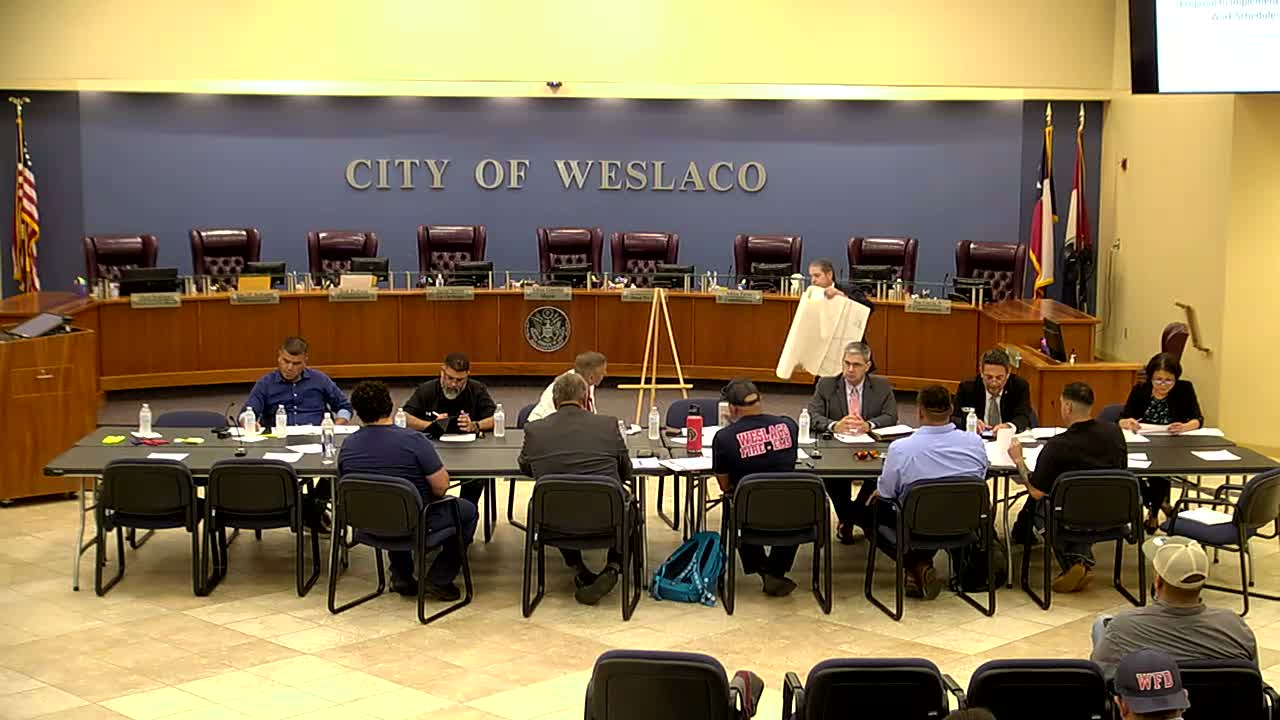
City negotiators and firefighters debated whether minimum staffing levels and new pay and wellness incentives should be codified in the collective bargaining agreement during a prolonged bargaining session.
City staff opened by confirming the union’s staffing article request and reading the financial estimate tied to the proposal, saying the three‑year cost for the staffing element and related items was roughly $1,028,074.65 for the staffing line and about $3,319,820 across the certification, fitness and wellness items presented to the commission. “That's based on the 18 firefighters that are being requested,” the city staff member said when listing the estimate.
The firefighters’ representative argued the city is growing and that the department’s Insurance Services Office rating — described by the speaker as “ISO 2” — prescribes 18 on‑duty personnel for a first alarm. The representative said the department often has far fewer firefighters available for structure fires and asked the commission to adopt contract language guaranteeing the higher minimum. “All we're asking is hey this is what we came up with. Let's get to the 18 that we need right now,” the presenter said.
City staff responded by reading Article 9 of the existing contract and emphasizing management’s retained rights. The staff member told negotiators that assigning shifts, determining staffing requirements and other operational decisions are managerial prerogatives that are normally resolved in the annual budget process. “There is no reason to do that because we talk about staffing every year in every budget year,” the city staff member said.
Negotiators then moved into operational specifics. Speakers noted four ambulance units are staffed and that two ambulances are committed to the county under contract, reducing the number of personnel available for structure‑fire responses. The parties also discussed hiring timelines and civil‑service rules that limit when new academy classes and hires can start. One union speaker said the department currently has four full‑time vacancies and that pay compression — roughly $35,000 starting pay for new hires in the presentation — was hampering recruitment and retention.
The session also covered non‑wage contract language known as the “me‑too” clause, under which firefighters receive a match if other city employee groups receive larger raises. Union negotiators said they had previously given the city retiree insurance in exchange for that language and proposed removing non‑civil service employees from the trigger so that only police raises would be matched; commissioners said any such change must be proposed in writing and negotiated.
City staff offered to provide a detailed cost breakdown of the proposals and to work with negotiators on priorities. Commissioners and union leaders agreed to exchange written proposals and to convene a subcommittee to verify the numbers and affected contract articles before the next bargaining session. The parties did not adopt any contract language or take a formal vote.
What happens next: city staff will provide the requested breakdowns of projected costs and the commission and union will schedule a subcommittee meeting to vet the numbers and the language changes before the next scheduled CBA meeting.