Get Full Government Meeting Transcripts, Videos, & Alerts Forever!
Get email alerts on the Infrastructure topic
No spam. Unsubscribe anytime.
Weslaco reviews $1.1M street overlay budget while overlay list totals $3.3M
Summary
Commissioners heard public-works staff describe an in-house paving program and a list of overlay needs totaling about $3.3 million; the city has $1.1 million budgeted next year and asked staff to return with a 12-month spending plan and priorities.
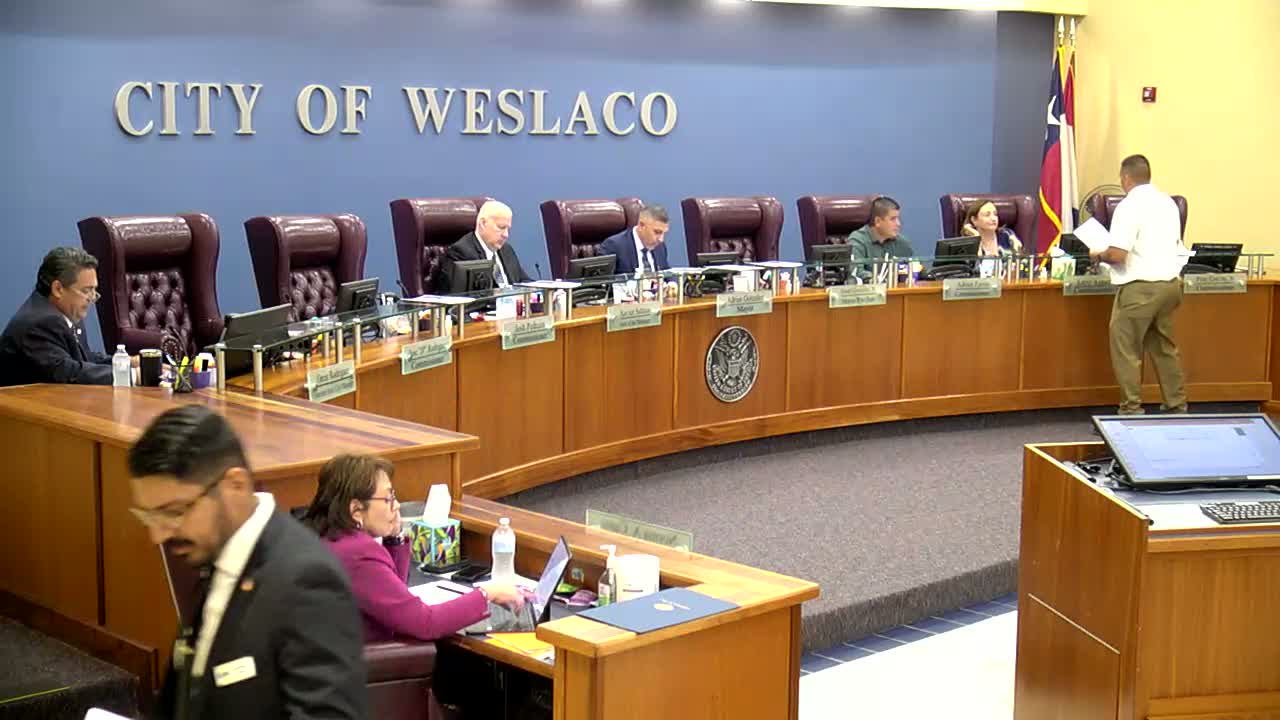
City staff reviewed a proposed street overlay program and a citywide list of needed overlays at a Sept. 2 Weslaco workshop, telling the commission the list totals roughly $3.3 million while available funding for the coming fiscal year is about $1.1 million.
Public works staff member David described Weslaco's in-house paving effort, which began around 2014'15 to stretch dollars by letting city crews handle many overlays. David said staff used visual inspections cross-checked with complaint-driven work orders (tracked back to 2021) and recommended considering a data-driven Pavement Management Index in future cycles.
Staff outlined the planned budget split for the program: about $850,000 for street overlays, $200,000 for striping and $100,000 for sidewalks, for a total of $1.1 million. Commissioners and staff noted that the full overlay list contains many additional needs; staff said the overlay list currently shows approximately $3.3 million in candidate projects.
Commissioners raised multiple operational concerns: whether short or 'orphan' streets were formally dedicated to the city and therefore eligible for paving; the need to coordinate overlay work with drainage and utility projects (to avoid repaving streets that will be cut up soon); and grouping nearby streets to reduce mobilization costs. Staff agreed to check plats on specific segments near the City Shop and to prioritize streets that will not be disrupted by planned utility or grant-funded projects.
The commission also discussed traffic-calming measures. Several members and a meeting participant described local requests for speed humps near schools and in subdivisions. Staff explained that speed tables typically require a formal speed study (informing FHWA/85th-percentile guidelines) and often a neighborhood petition; valley gutters and other drainage design elements depend on the engineer's drainage plan and are not automatic.
Staff told the commission it would return with a recommended 12-month plan for spending the $1.1 million, clustered by neighborhoods or quadrants to maximize efficiency. The workshop record shows commissioners asked staff to prepare that report and to include crossings, drainage needs and potential bond/grant-funded projects that could remove items from the overlay list.
Procedural note: near the end of the workshop a motion to go into executive session passed by voice vote; no formal roll-call tally was recorded in the workshop transcript.
Next steps: staff will pull plats for disputed streets, draft a prioritized 12-month overlay plan that aligns overlays with utility/drainage work, and return to the commission for formal action.