Get Full Government Meeting Transcripts, Videos, & Alerts Forever!
Get email alerts on the Public Health topic
No spam. Unsubscribe anytime.
Burleson staff recommends keeping targeted mosquito spraying after 2025 season; council signals support
Summary
Public‑works staff presented 2025 mosquito surveillance showing no human West Nile cases in Burleson and recommended continuing targeted fogging when traps test positive; council generally favored maintaining the current program while exploring pilot steps (bat boxes, habitat enhancements).
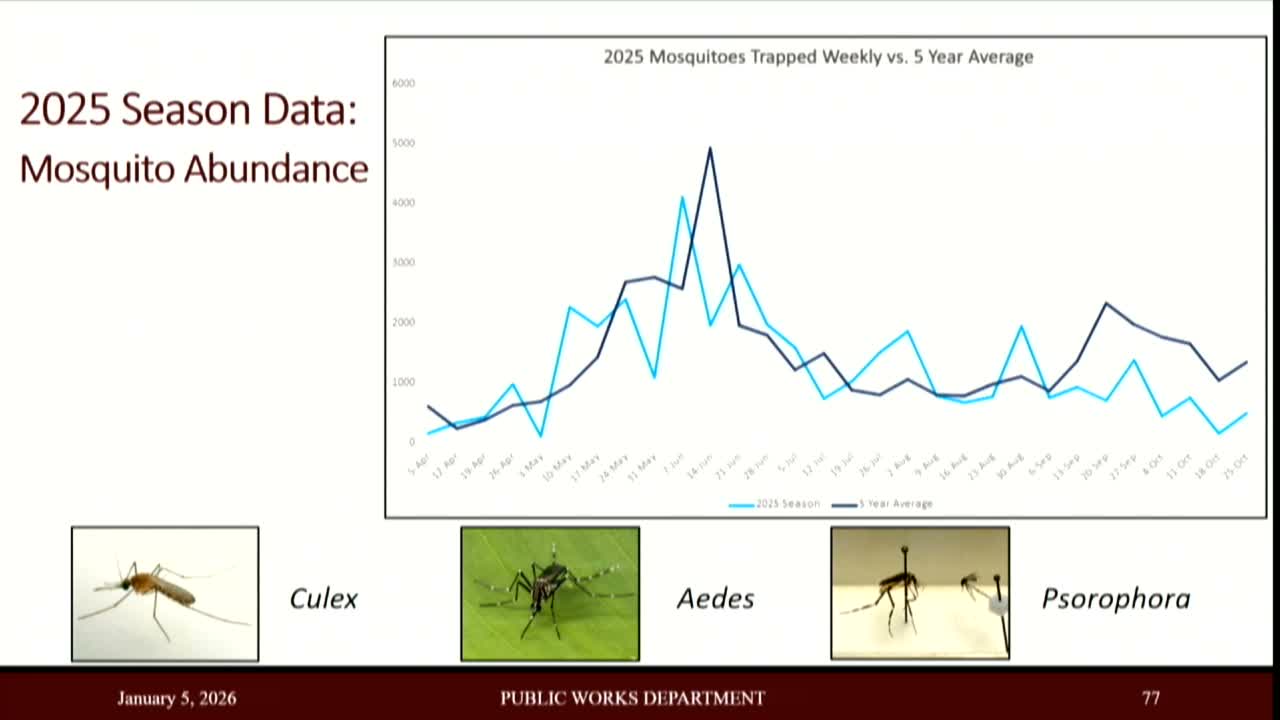
Burleson public‑works Director Eric Thompson told the City Council on Jan. 5 that the city’s Integrated Mosquito Management program produced a near‑average year in 2025 and that Tarrant County lab results showed no human West Nile cases in Burleson last year. Thompson said staff uses weekly trap monitoring, targeted larvicide and strategic fogging when traps test positive, and that additional testing at a state lab found no evidence of permethrin resistance in city samples.
"We'd like to keep that 0 number," Thompson said, referring to human cases in the city, and presented three options for 2026: keep the current approach of fogging targeted zones after positive trap results; adopt a risk‑based threshold tied to trap counts; or follow the county’s newer policy of requiring three weeks of consecutive positives at a site before fogging. Thompson told council the cost differences among the options were modest but that the status quo offered the best chance to prevent human cases.
Council members pressed for detail on the lab testing and costs. Thompson said staff collects pre‑ and post‑fogging samples and had sent extra samples to a state lab for resistance testing, which confirmed permethrin remained effective in Burleson. He provided a five‑year spending history for fogging and larvicide (about $32,000 in 2025, versus $83,000 in the high year of 2024) and estimated moderate savings under a higher threshold policy but warned it carried some additional public‑health risk.
Several council members urged caution about following Tarrant County’s move to wait three consecutive positive weeks; one council member noted suspected resistance in unincorporated county areas and said Burleson was not yet seeing the same pattern. The council also discussed nonchemical options Thompson had raised, including bat boxes and habitat plantings, and suggested piloting low‑cost measures with civic groups (scouts, churches) while monitoring outcomes.
Staff will bring detailed cost comparisons and a proposed phase‑response plan back to council for direction; council signaled general support for continuing the city’s current targeted approach while testing limited, community‑led pilot measures.